


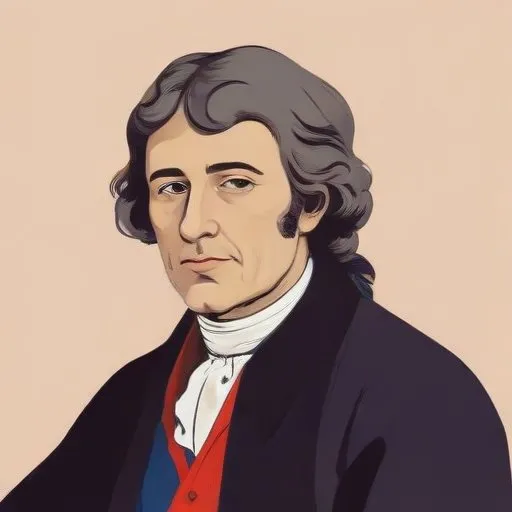
A prominent literary critic and writer who played a significant role in shaping French literature during the Enlightenment era, known for his influential reviews and essays that helped establish the reputations of prominent authors.
JeanFranois de La Harpe, born on November 20, 1739, was a French playwright, writer, and literary critic, renowned for his biting critiques and razor-sharp wit. He is best known for his plays, including his masterpiece, Warwick, which premiered before the French court in 1763, and his influential literary magazine, Lycée, which shaped the literary landscape of 18th-century France.
La Harpe's early life was marked by hardship and misfortune. Born to poor parents in Paris, he was orphaned at the age of nine and was taken in by the Sisters of Charity for six months. His education was later sponsored by a scholarship at the prestigious Collège d'Harcourt, now known as the Lycée Saint-Louis.
However, his time at the college was not without controversy. At the age of nineteen, he was imprisoned for several months on the charge of writing a satire against his protectors at the college. Although he denied any wrongdoing, this experience likely contributed to the bitterness and acerbity that characterized his later writing.
La Harpe's literary career began to take off in the early 1760s, with the success of his tragedy, Warwick, in 1763. This play, his first major work, was performed before the court and received widespread acclaim. Its success led to a correspondence with the great Voltaire, who held La Harpe in high esteem and even allowed him to correct his verses.
La Harpe's subsequent plays, Timoléon (1764) and Pharamond (1765), although not as successful as Warwick, demonstrated his continued growth as a playwright. His literary talents also extended to literary criticism, as evident in his scathing reviews of his contemporaries' works.
La Harpe's personal life was not without its struggles. His marriage to the daughter of a coffee house keeper in 1764 proved unhappy and was eventually dissolved. He and his wife were forced to live in poverty, relying on the charity of friends, including Voltaire, who hosted them at his estate in Ferney.
La Harpe's relationship with Voltaire was complex and tumultuous. Although Voltaire was a mentor and friend, La Harpe's criticism of the philosopher's works after his death was seen as a betrayal by many. This perceived treachery led to a backlash against La Harpe, further complicating his already troubled life.
Despite the controversies surrounding his life, La Harpe's literary contributions are undeniable. His magazine, Lycée, which he founded in 1796, was instrumental in shaping the literary tastes of 18th-century France. His biting critiques and reviews helped to establish him as a formidable literary force, feared and respected by his contemporaries.
Today, La Harpe's plays and literary critiques continue to offer a unique glimpse into the literary landscape of 18th-century France. His tumultuous life, marked by both triumph and struggle, serves as a testament to the power of literary talent to transcend adversity.
"The only thing I know is that I know nothing, and I am not even sure of that."
"To be a good critic, one must be a good writer, and to be a good writer, one must be a good critic."
La Harpe's legacy extends beyond his literary contributions to his impact on modern society. His notion that literature should be a reflection of reality, rather than an escape from it, continues to influence literary theory and criticism today.
Furthermore, his emphasis on the importance of literary criticism as a means of shaping literary tastes and fostering intellectual growth remains a cornerstone of literary education.
La Harpe's legacy can be seen in the many literary and cultural movements that followed him. From the Romantic poets to the Existentialists, his influence can be traced in the works of writers and thinkers who sought to challenge the status quo and push the boundaries of literary expression.
In the world of pop culture, La Harpe's scathing critiques and biting wit have inspired generations of satirists, comedians, and social commentators.
La Harpe was elected to the Académie Française in 1786, a testament to his standing as a literary giant of his time.
Today, his legacy is celebrated through various literary awards and honors, including the Prix Jean-François de La Harpe, established in his name to recognize excellence in literary criticism and writing.
Born in 1694
A witty and insightful 18th-century writer and philosopher who used satire to critique societal norms and advocate for reason, tolerance, and human rights.
Born in 1712
A pioneering thinker who shaped modern democracy and education with his ideas on social contracts, general will, and the importance of early childhood education. His writings influenced the French Revolution and modern political thought.
Born in 1689
A French lawyer and philosopher who developed the concept of separation of powers, which divides a government into legislative, executive, and judicial branches to prevent abuse of power. His ideas greatly influenced modern democracy.
Born in 1717
A French Enlightenment thinker who made significant contributions to mathematics, physics, and philosophy, particularly in the fields of fluid dynamics and the study of vibrating strings. He's also known for his work on the Encyclopedia, a comprehensive reference work that aimed to compile all knowledge of the time.
Born in 1714
A French philosopher who developed a comprehensive system of philosophy that emphasized the role of sensation and experience in shaping our understanding of the world, and is known for his influential works on epistemology and psychology.
Born in 1741
A witty and insightful French writer who penned biting social commentary and clever aphorisms, known for his sharp observations on human nature and society.
Born in 1606
A 17th-century French mastermind behind iconic plays like "Le Cid" and "Horace", known for pioneering the classical French tragedy genre.
