


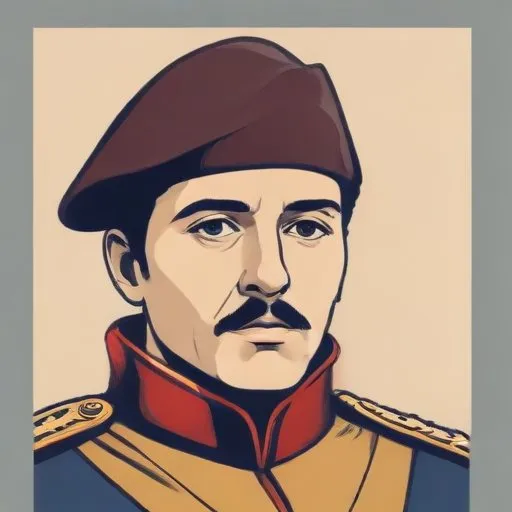
A French Enlightenment thinker who wrote about ethics, politics, and literature, and is particularly famous for his poem "Les Saisons" which inspired Vivaldi's "Four Seasons" composition.
Jean Franois de SaintLambert was a French poet, philosopher, and military officer, best known for his magnum opus, "The Seasons," a work that would define his legacy in the world of French literature.
SaintLambert was born on December 26, 1716, in Nancy, France, and was raised on his parents' estate at Affracourt, a village in Lorraine near Harou. He studied at the University of Pont-à-Mousson, but his education was interrupted by an unidentified illness that forced him to spend several years at home recuperating.
SaintLambert began writing poetry in his adolescence and was part of Françoise de Graffigny's social circle in Lunéville. His most famous work, "The Seasons," was started in 1733, but it took him over 30 years to complete and publish it in 1769. Despite not rushing to publish his works, SaintLambert was known to read them in salons and to his friends, who appreciated his unique style and philosophical insights.
In 1739, SaintLambert joined the Heudicourt regiment in the Lorraine Guards, where his boyhood friend, Charles-Just, prince de Beauvau-Craon, was already a colonel. Together, they fought side by side in the Italian campaigns of the War of the Austrian Succession. SaintLambert's personal life was also marred by scandals and controversies, including an alleged affair with the Marquise de Boufflers, a mistress of Stanislaus Leszczynski, the Duke of Lorraine.
SaintLambert's most notable romantic liaison was with Émilie du Châtelet, Voltaire's mistress, whom he met in Lunéville in 1747. Their affair resulted in a pregnancy, and they had a daughter named Stanislas-Adélaïde Du Châtelet. SaintLambert's relationships with powerful women and his association with Voltaire's circle marked him as a prominent figure in French literary and philosophical circles.
SaintLambert's "The Seasons" is considered a masterpiece of French literature, offering a philosophical and poetic reflection on the human experience. Through his work, SaintLambert explored themes of nature, morality, and the human condition, influencing generations of French writers and thinkers. His legacy extends beyond literature, as he played a significant role in shaping French cultural and intellectual identity during the Enlightenment era.
SaintLambert's philosophical contributions were deeply rooted in the Enlightenment values of reason, individualism, and tolerance. His work reflected a strong sense of curiosity and inquiry, as he explored the intersections of science, morality, and aesthetics. SaintLambert's philosophical ideas were shaped by his associations with prominent thinkers like Voltaire and Émilie du Châtelet, and he, in turn, influenced many prominent French intellectuals of his time.
Jean Franois de SaintLambert's life was marked by intellectual curiosity, literary innovation, and personal scandals. Through his work, he left an indelible mark on French literature and philosophy, shaping the cultural and intellectual landscape of the Enlightenment era. His legacy continues to inspire and influence writers, thinkers, and scholars to this day.
Born in 1694
A witty and insightful 18th-century writer and philosopher who used satire to critique societal norms and advocate for reason, tolerance, and human rights.
Born in 1712
A pioneering thinker who shaped modern democracy and education with his ideas on social contracts, general will, and the importance of early childhood education. His writings influenced the French Revolution and modern political thought.
Born in 1689
A French lawyer and philosopher who developed the concept of separation of powers, which divides a government into legislative, executive, and judicial branches to prevent abuse of power. His ideas greatly influenced modern democracy.
Born in 1724
Developed influential philosophical frameworks, such as the Critique of Pure Reason, that shaped modern Western thought on ethics, morality, and human understanding.
Born in 1717
A French Enlightenment thinker who made significant contributions to mathematics, physics, and philosophy, particularly in the fields of fluid dynamics and the study of vibrating strings. He's also known for his work on the Encyclopedia, a comprehensive reference work that aimed to compile all knowledge of the time.
Born in 1749
Developed nebular hypothesis of the origin of the solar system and formulated Laplace's equation, a fundamental concept in mathematics and physics. He's considered the founder of celestial mechanics.
