


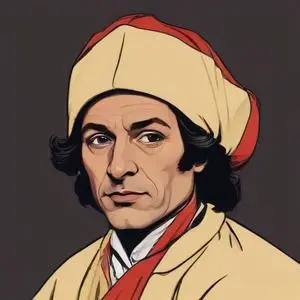
A radical Jacobin leader who advocated for the execution of King Louis XVI and was a key figure in the Reign of Terror during the French Revolution, known for his extreme views and assassination in his bathtub.
Radical journalist, physician, and scientist, Jean-Paul Marat is best known for his unwavering defense of the sansculottes, a radical voice that shaped the course of the French Revolution. Through his provocative writings, he became an unofficial link to the Jacobin group, which came to power in June 1793, earning him both admiration and notoriety.
Born on May 24, 1743, in Boudry, Switzerland, Marat was raised in a family of modest means. Despite their financial struggles, his parents encouraged his education, which led him to pursue studies in philosophy, science, and medicine.
Marat's early works showcased his passion for science, particularly in the fields of electricity and optics. His research earned him recognition from the Royal Society of Medicine, and he became a fellow of the society in 1775. However, it was his writing that truly set him apart, as he began publishing pamphlets, placards, and newspapers that critiqued the social and political landscape of France.
Marat's periodical, L'Ami du peuple (The Friend of the People), became a platform for his radical views, championing the cause of the sansculottes and demanding greater accountability from the new leaders and institutions of the revolution. His journalism was known for its unbridled ferocity and uncompromising stance, earning him both admiration and enmity.
Marat's legacy extends beyond the French Revolution, as his ideas and writings influenced the development of socialist thought, shaping the course of modern politics and social movements. His commitment to social justice and his critique of economic inequality continue to resonate with contemporary audiences.
Tragically, Marat's life was cut short when Charlotte Corday, a Girondin sympathizer, assassinated him on July 13, 1793, while he was taking a medicinal bath for his debilitating skin condition. Corday was executed four days later for his assassination. In death, Marat became an icon to the Montagnards and sansculottes, cementing his status as a revolutionary martyr.
The most famous painter in Paris, Jacques-Louis David, immortalized Marat in his iconic painting, The Death of Marat. David's masterpiece captures the tragic circumstances of Marat's death, forever etching his image in the collective consciousness of the French people.
Marat's contemporaries, such as Maximilien Robespierre and Georges Danton, shared his passion for revolution and social justice. However, Marat's unwavering commitment to the sansculottes set him apart, earning him both admiration and criticism from his peers.
Marat's relationships with fellow revolutionaries, including Jacques-Louis David, were marked by mutual respect and admiration. His personal struggles, including his skin condition, only added to his mystique as a champion of the people.
Marat's legacy extends beyond the realm of politics, influencing art, literature, and music. From Jacques-Louis David's painting to modern-day adaptations, Marat's story continues to captivate audiences, inspiring new generations of artists and writers.
In conclusion, Jean-Paul Marat's fiery spirit, unwavering commitment to social justice, and passion for revolution cement his place in history as a champion of the people. His legacy continues to inspire and provoke, ensuring his relevance in modern times.
Born in 1758
Radical leader of the French Revolution, instrumental in the Reign of Terror, and advocate for the execution of King Louis XVI.
Born in 1759
A leading figure of the French Revolution, instrumental in the overthrow of the monarchy and establishment of the First French Republic, known for his radical Jacobin ideology.
Born in 1755
A key figure in the French Revolution, leading the coup that overthrew Maximilien Robespierre and later serving as a key advisor to Napoleon Bonaparte. He played a crucial role in shaping French politics during a tumultuous period.
Born in 1760
French journalist and politician who sparked the French Revolution with his impassioned speeches and writings, advocating for democracy and social reform.
Born in 1768
French revolutionary radical who stabbed to death a prominent Jacobin leader in his bathtub, symbolizing the end of the Reign of Terror.
Born in 1769
A French military leader who rose to prominence during the French Revolution and became Emperor of France, known for his military conquests and reorganization of Europe. He is also famous for his Napoleonic Code, which remains a foundation of modern law.
