


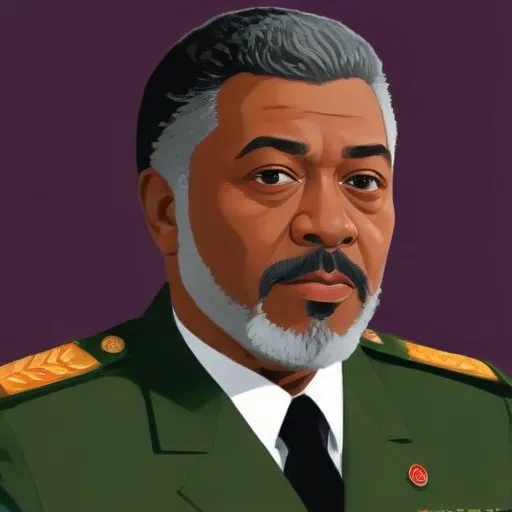
Led a military coup and later became the democratically elected President of Ghana, known for his efforts to reform the country's economy and promote democracy.
Jerry Rawlings, a Ghanaian military coup leader, aviator, and politician, led the country through a series of transformative periods, leaving an indelible mark on Ghana's history. Known for his charismatic leadership and radical policies, Rawlings ruled Ghana twice, first as a military leader from 1979 to 1981 and then as a democratically elected president from 1992 to 2001.
Rawlings was born on June 22, 1947, in Accra, Ghana, to Victoria Agbotui, an Anlo Ewe, and James Ramsey John, a British chemist. He attended Achimota School and later joined a military academy at Teshie, where he developed his passion for flying.
In 1979, Rawlings led a successful coup d'état, overthrowing the ruling military government just five weeks before scheduled democratic elections. Although he handed power over to a civilian government, he returned to power in 1981, leading a military coup as the chairman of the Provisional National Defence Council (PNDC).
In 1992, Rawlings resigned from the military, founded the National Democratic Congress (NDC), and became the first president of the Fourth Republic. He was reelected in 1996 for another four-year term. During his presidency, Rawlings implemented several reforms, including the establishment of the National Health Insurance Scheme and the National Youth Employment Programme.
Rawlings was known for his commitment to pancreatic socialist ideals, which emphasized social justice, equity, and national self-reliance. He believed in the need for Ghana to break free from its colonial past and forge its own path to development.
Rawlings was married to Nana Konadu Agyeman, with whom he had four children: Zanetor Rawlings, Yaa Asantewaa Rawlings, Amina Rawlings, and Kimathi Rawlings. He was also an avid aviator and held a commercial pilot's license.
Rawlings' leadership had a significant impact on Ghanaian society, particularly in the areas of education and healthcare. He introduced the Free Compulsory Universal Basic Education (FCUBE) program, which increased access to education for millions of Ghanaians. Additionally, he established the National Health Insurance Scheme, which improved healthcare outcomes across the country.
Rawlings was known for his charisma and wit, often peppered with humorous one-liners. One of his most famous quotes is: "No one can stop the sun from shining!"
Rawlings' leadership was marked by controversy and criticism, particularly during his early years as a military leader. However, his later years as a democratically elected president were marked by significant reforms and development. His legacy continues to be debated among Ghanaians, with some hailing him as a hero and others criticizing his authoritarian tendencies.
Rawlings received several awards and honors, including the Order of the Volta, Ghana's highest national honor.
Rawlings was not without controversy, particularly during his early years as a military leader. He faced criticism for human rights abuses, corruption, and authoritarianism. However, his later years as a democratically elected president were marked by increased transparency and accountability.
Rawlings' legacy extends beyond politics, with his charismatic personality and radical ideals influencing popular culture in Ghana. He was often portrayed in films, music, and literature as a symbol of resistance and social change.
Rawlings was involved in several charitable initiatives, including the establishment of the Jerry John Rawlings Foundation, which focused on education, healthcare, and social welfare.
Rawlings' life is a testament to the power of perseverance and determination. His commitment to pan-Africanist ideals and social justice continues to inspire generations of Ghanaians and Africans.
Jerry Rawlings passed away on November 12, 2020, at the age of 73, leaving behind a complex and contested legacy. Nevertheless, his impact on Ghana's history and development remains undeniable.
Born in 1909
First President of Ghana, leading the country to independence from British colonial rule and promoting Pan-Africanism. He's known for his vision of a united Africa and his role in shaping modern Ghana.
