


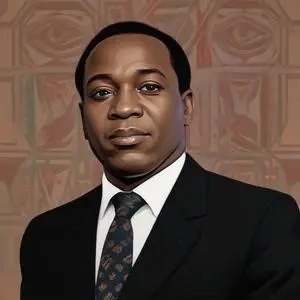
First President of Ghana, leading the country to independence from British colonial rule and promoting Pan-Africanism. He's known for his vision of a united Africa and his role in shaping modern Ghana.
Kwame Nkrumah, a Ghanaian politician, political theorist, and revolutionary, is renowned for being the first Prime Minister and President of Ghana, leading the country to independence from British colonial rule in 1957. As a pioneering advocate of Pan-Africanism, Nkrumah played a pivotal role in shaping the modern African nation and promoting unity among African states.
Born on September 21, 1909, in Nkroful, Gold Coast (now Ghana), Nkrumah was raised in a family of farmers and traders. He pursued higher education in the United States, studying at Lincoln University in Pennsylvania and later at the University of Pennsylvania, where he earned a degree in economics and philosophy.
After 12 years abroad, Nkrumah returned to the Gold Coast in 1947, determined to fight for national independence. He formed the Convention People's Party (CPP), which rapidly gained popularity among the common people. In 1951, the CPP won a majority of seats in the Legislative Council elections, and Nkrumah became the leader of government business.
In 1952, Nkrumah became the Prime Minister of the Gold Coast, and in 1957, he led Ghana to independence from Britain. As President, he implemented policies aimed at rapid industrialization, education, and cultural development. His administration established the University of Ghana, the Ghana National Steel Works, and the Akosombo Dam, among other projects.
Nkrumah was a founding member of the Organization of African Unity (OAU) and played a key role in promoting African unity and cooperation. He was a strong advocate for the eradication of colonialism and imperialism in Africa and received the Lenin Peace Prize from the Soviet Union in 1962.
In the 1960s, Nkrumah's administration became increasingly authoritarian, marked by the repression of political opposition and the suppression of civil liberties. In 1964, Ghana became a one-party state, with Nkrumah as president for life. However, in 1966, he was overthrown in a military coup, led by the National Liberation Council.
Nkrumah spent the remainder of his life in exile in Guinea, where he was named honorary co-president. Despite his later years being marked by controversy, Nkrumah's contributions to Ghana's independence and African unity remain unmatched. He died on April 27, 1972, but his legacy continues to inspire generations of Africans and people around the world.
Some of Nkrumah's notable quotes include:
Nkrumah's life and work span a tumultuous period in African history, marked by decolonization, the Cold War, and the rise of Pan-Africanism. His legacy serves as a testament to the power of visionary leadership and the struggle for African independence and unity.
Born in 1922
First President of Tanzania, led the country to independence from British colonial rule and implemented socialist policies, known for his Pan-Africanism and anti-colonialism efforts.
Born in 1922
First President of Guinea, led country to independence from France in 1958, and implemented socialist policies. Known for his Pan-Africanism and anti-colonial stance.
Born in 1892
The last emperor of Ethiopia, who led the country through a period of modernization and was a symbol of African independence, and is also revered as a deity by the Rastafari movement.
Born in 1925
The first Prime Minister of the Democratic Republic of the Congo, a key figure in the country's struggle for independence from Belgium, and a symbol of African nationalism. He played a crucial role in shaping the country's early years, but his life was cut short by assassination.
