


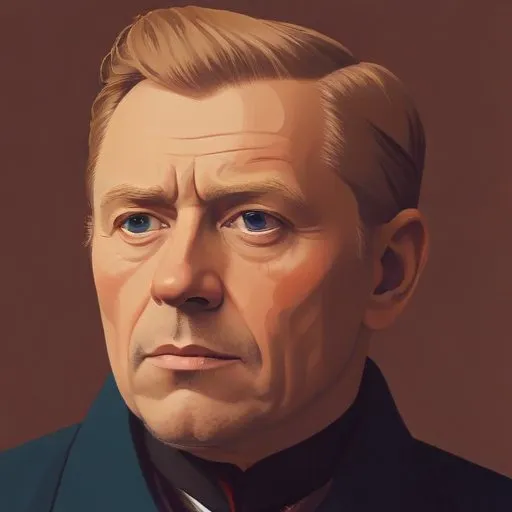
Danish statesman who played a crucial role in the country's transition from absolute monarchy to constitutional monarchy in the 19th century, known for his efforts to establish a more democratic government.
Johan Friis, a prominent Danish statesman, is renowned for his exceptional leadership and instrumental role in shaping Denmark's history during the 16th century. As the Chancellor under King Christian III of Denmark, Friis played a pivotal role in the nation's governance, exercising immense influence during the reign of three consecutive monarchs.
Born on February 20, 1494, at Lundbygård Manor, Friis was the son of Jesper Friis and Anne Johansdatter Brockenhuus. He pursued his education in Odense and Copenhagen before completing his studies in Cologne and Rome, laying the foundation for his future success.
Friis was one of the first Danish nobles to support the Protestant Reformation, siding with King Frederick I of Denmark (1523-1533). His allegiance earned him the position of Chancellor in 1532, a post he held until his death in 1570. During this period, he played a crucial role in the government, skillfully navigating the complexities of the Danish monarchy.
Friis's influence extended beyond Denmark's borders. He was instrumental in the election of King Christian III of Denmark (1534-1559) and later took part in the negotiations with Lübeck at the peace in Hamburg (February 1536). His diplomatic prowess earned him recognition as a skilled mediator, able to balance the interests of Danish and German parties vying for supremacy.
Following the Reformation, Friis played a vital role in Denmark's national reconstruction. As a moderate Lutheran, he brought stability and calmness to the tumultuous period, effectively mediating between rival factions. His commitment to education led to his appointment as the first Rector of the reconstructed University of Copenhagen, where he left a lasting legacy as the first donor of a legacy to the institution.
Friis's remarkable life was marked by significant milestones, including his escape from captivity during the Counts War, where he was forced to do homage to Christopher, Count of Oldenburg. Subsequently, he rejoined Christian III, continuing to shape Denmark's destiny. His calm and measured approach earned him the respect of his contemporaries, solidifying his place in Danish history.
Johan Friis's remarkable journey, marked by his unwavering dedication to Denmark and its people, has left an indelible mark on the nation's history. His legacy continues to inspire, a shining example of effective leadership and statesmanship.
Born in 1609
King of Denmark and Norway from 1648 to 1670, known for establishing absolute monarchy and modernizing Denmark's administration.
Born in 1749
King of Denmark and Norway from 1766 to 1808, known for his mental health issues and scandals, which led to a regency that ruled in his place.
Born in 1818
The King of Denmark who unified the country and founded the modern Danish monarchy, known for his strong leadership and family ties to European royal houses.
Born in 1723
King of Denmark and Norway from 1746 to 1766, known for his cultural and economic reforms, as well as his patronage of the arts.
Born in 1646
King of Denmark and Norway from 1670 to 1699, known for his military campaigns and establishment of the Danish absolute monarchy. He also commissioned the famous Danish atlas, Atlas Danicus.
