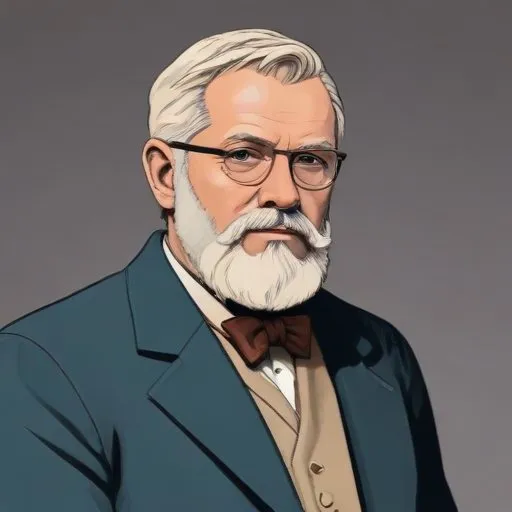
Johan Georg Forchhammer: The Danish Pioneer of Mineralogy and Geology
A Legacy of Discovery and Innovation
Johan Georg Forchhammer is renowned for his groundbreaking contributions to the fields of mineralogy and geology. His most notable achievement is the formulation of Forchhammer's Principle, also known as the Principle of Constant Proportions, which states that the ratio of major salts in seawater remains constant across different locations.
Early Life and Education
Born on July 26, 1794, in Husum, Schleswig, Forchhammer pursued his higher education at the universities of Kiel and Copenhagen from 1815 to 1818. His academic endeavors laid the foundation for his future accomplishments in the realm of mineralogy and geology.
Career Highlights and Major Works
Forchhammer's career was marked by several notable milestones. He joined Hans Christian Ørsted and Lauritz Esmarch on a mineralogical expedition to Bornholm, contributing significantly to the team's efforts. In 1820, he earned his doctorate with a chemical treatise titled "De mangano." This achievement was followed by a journey through England, Scotland, and the Faroe Islands, where he expanded his knowledge and gained valuable experience.
Academic Appointments and Contributions
In 1823, Forchhammer was appointed as a lecturer at Copenhagen University, where he taught chemistry and mineralogy. He subsequently obtained a similar post at the newly established polytechnic school in 1829. His academic appointments culminated in 1831, when he became a professor of mineralogy at Copenhagen University.
Geological Survey of Denmark
From 1835 to 1837, Forchhammer made substantial contributions to the geological survey of Denmark. His work during this period laid the groundwork for future geological research in the country.
Forchhammer's Principle and Its Impact
Forchhammer's most significant contribution to science is his conjecture that the ratio of major salts in seawater remains constant across different locations. This principle, formulated in 1865, was later proven correct by Prof. William Dittmar in 1884. Forchhammer's Principle has had a lasting impact on our understanding of seawater composition and has far-reaching implications for various fields, including oceanography and marine biology.
Public Instructer and Practical Contributions
Forchhammer was an influential public instructor who contributed significantly to the advancement of his field. He played a key role in introducing gas lighting to Copenhagen, establishing the fire brigade at Rosenborg, and promoting the use of artesian wells.
Awards and Honors
Forchhammer's outstanding contributions to science and education earned him numerous awards and honors. He succeeded Hans Christian Ørsted as the director of the polytechnic school and secretary of the Academy of Sciences in 1851.
Personal Milestones and Legacy
Throughout his life, Forchhammer remained dedicated to his work, leaving behind a legacy of discovery and innovation. His contributions to mineralogy, geology, and education continue to inspire future generations of scientists and scholars.
Final Thoughts
Johan Georg Forchhammer's remarkable career is a testament to his boundless enthusiasm for scientific inquiry and his commitment to advancing human knowledge. His pioneering work in mineralogy and geology has left an indelible mark on the scientific community, earning him a place among the most distinguished scientists of his time.
FAQ
What was Johan Georg Forchhammers contribution to the field of mineralogy?
Johan Georg Forchhammer was a Danish mineralogist and geologist who made significant contributions to the field of mineralogy, particularly in the areas of crystallography and mineral classification.
What was Johan Georg Forchhammers role in the discovery of new minerals?
Johan Georg Forchhammer was instrumental in the discovery of several new minerals, including thorite and monazite. He also developed new methods for analyzing and identifying minerals.
What was Johan Georg Forchhammers relationship with Hans Christian Ørsted?
Johan Georg Forchhammer had a close relationship with Hans Christian Ørsted, a Danish physicist and chemist who discovered electromagnetism. The two men collaborated on several projects and shared a passion for scientific discovery.
What is Johan Georg Forchhammers most famous work?
Johan Georg Forchhammers most famous work is his textbook on mineralogy, which was published in 1822 and became a standard reference in the field.
What is Johan Georg Forchhammers legacy?
Johan Georg Forchhammers legacy is that of a pioneering mineralogist and geologist who contributed significantly to our understanding of the natural world. He is remembered for his groundbreaking research and his passion for scientific discovery.