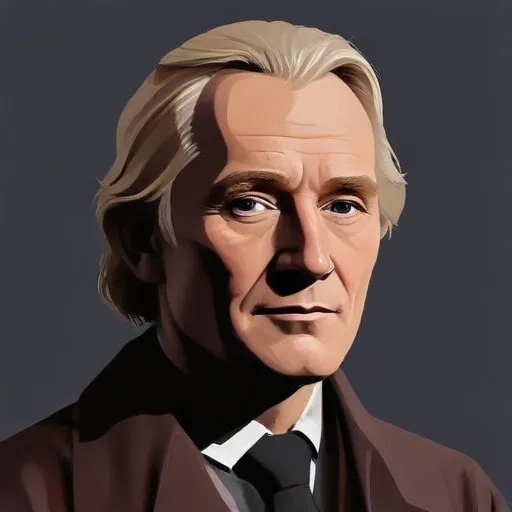
Johan Sebastian Welhaven: A Luminary of Norwegian Literature
A Life of Letters and Literary Criticism
Johan Sebastian Welhaven, born in 1807, was a Norwegian writer, poet, critic, and art theorist who left an indelible mark on the country's literary landscape. He is widely regarded as one of the greatest figures in Norwegian literature, and his contributions to the world of letters continue to inspire and influence writers to this day.
Family and Early Life
Welhaven was born in Bergen, Norway, to a family of intellectuals and clergy. His grandfather, Johan Andrew Welhaven, was a teacher and assistant to the pastor at St. Mary's Church, while his father, Johan Ernst Welhaven, was a pastor at St. George's Hospital. His mother, Else Margaret Cammermeyer, was the daughter of Johan Sebastian Cammermeyer, resident chaplain of Holy Cross Church. Welhaven's family was steeped in the traditions of literature and education, and it was only natural that he would follow in their footsteps.
Education and Early Career
Welhaven attended Bergen Cathedral School from 1817 to 1825, before moving to Christiania (now Oslo) to pursue his studies. In 1828, he began studying theology under the supervision of his father, but after his father's untimely death, Welhaven continued his studies at the University of Christiania. He graduated in 1827 and devoted himself to literature, eventually becoming a lecturer in philosophy at the Royal Frederiks University in Christiania in 1840.
Travels and Inspirations
Welhaven's travels played a significant role in shaping his literary style and philosophical outlook. In 1836, he visited France and Germany, where he was exposed to the works of prominent Romantic writers and thinkers. In 1858, he traveled to Italy to study archaeology, which further broadened his cultural and intellectual horizons.
Literary Contributions and Controversies
Welhaven's appointment as a lecturer in philosophy in 1840 was not without controversy. He had not completed his theological degree, and many felt that he lacked the necessary qualifications for the position. Despite this, Welhaven went on to deliver a series of influential lectures on literary subjects, which cemented his reputation as a leading literary figure.
Personal Life and Legacy
Welhaven's personal life was marked by tragedy and loss. His sister, Maren Sars, was a socialite and the wife of theologian and biologist Michael Sars. His son, Hjalmar Welhaven, would go on to become a prominent Norwegian architect. In 1873, Welhaven passed away, leaving behind a legacy of literary works that continue to inspire and influence Norwegian writers to this day.
Major Works and Philosophical Contributions
Welhaven's literary output was diverse and far-reaching. He wrote poetry, essays, and literary criticism, and was particularly interested in the intersection of art and philosophy. His works include:
- "Digte" (Poems), a collection of poetry that showcases his mastery of language and form.
- "Lærebog i Philosophien" (Textbook of Philosophy), a comprehensive guide to philosophical thought that reflects his interests in aesthetics and ethics.
- "Om Kunst og Kultur" (On Art and Culture), a series of essays that explore the relationship between art, culture, and society.
Influence on Modern Society
Welhaven's influence on modern society is palpable. He played a significant role in shaping Norway's literary identity and continues to inspire writers and thinkers around the world. His philosophical contributions, which emphasize the importance of aesthetics and culture, have had a lasting impact on our understanding of the human experience.
Quotes and Memorable Sayings
Welhaven's writings are peppered with memorable sayings and quotes that continue to inspire and delight readers. One of his most famous quotes is: "Art is the highest form of human expression, for it speaks to our deepest desires and highest aspirations."
FAQ
What type of literature did Johan Sebastian Welhaven write?
Welhaven was a Norwegian author, poet, and critic who wrote primarily in the genres of poetry and literary criticism.
What was Johan Sebastian Welhavens role in Norwegian literature?
Welhaven was a prominent figure in Norwegian literature, known for his contributions to the countrys literary scene and his influence on later writers.
What was Johan Sebastian Welhavens style of writing?
Welhavens writing style was characterized by its lyricism and romanticism, reflecting his interest in the beauty of nature and the human experience.
What were some of Johan Sebastian Welhavens most famous works?
Some of Welhavens most famous works include his poetry collections Digte and Norsk_nat, as well as his critical essays on Norwegian literature.
What legacy did Johan Sebastian Welhaven leave behind?
Welhavens legacy lies in his contributions to Norwegian literature and his influence on later writers, as well as his role in shaping the countrys cultural identity.