


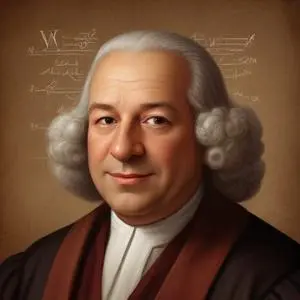
A renowned 17th-century mathematician who made significant contributions to the development of calculus, probability, and optics, leaving an indelible mark on the scientific community.
Johann Bernoulli, a renowned Swiss mathematician, is credited with making significant contributions to infinitesimal calculus and shaping the future of mathematics. Alongside his brother Jacob, he was one of the first mathematicians to not only study and understand calculus but also apply it to various problems, leaving an indelible mark on the field.
Born on August 6, 1667, in Basel, Switzerland, Johann Bernoulli was the son of Nicolaus Bernoulli, an apothecary, and his wife, Margarethe Schongauer. His father desired that he study business to take over the family spice trade, but Johann had other plans. He convinced his father to allow him to study medicine instead, and simultaneously pursued mathematics on the side with his older brother Jacob.
During his education at the University of Basel, the Bernoulli brothers worked together, exploring the newly discovered infinitesimal calculus. This collaboration laid the foundation for Johann's future accomplishments in the field.
Johann Bernoulli's most notable contribution was his work on infinitesimal calculus, which he applied to various problems in physics, astronomy, and engineering. He was one of the first mathematicians to use calculus to study the motion of planets, the behavior of fluids, and the properties of light.
In 1691, he wrote his dissertation, De Motu musculorum et de effervescent et fermentation, which was reviewed by Gottfried Wilhelm Leibniz, a prominent German philosopher and mathematician. This work showcased Bernoulli's mastery of calculus and his ability to apply it to real-world problems.
After completing his degree, Johann Bernoulli moved to teach differential equations and later accepted a position as the professor of mathematics at the University of Groningen in 1694. He remained in this position until 1705, when he returned to Basel to take over as professor of mathematics at the University of Basel, a position previously held by his brother Jacob.
Bernoulli's most notable work is his Ars Conjectandi, a comprehensive treatise on probability theory, which was published posthumously in 1713. This work introduced the concept of the Bernoulli distribution and laid the foundation for modern probability theory.
In 1694, Johann Bernoulli married Dorothea Falkner, the daughter of an alderman of Basel. The couple had two children, Nicolaus and Daniel, who would go on to become mathematicians in their own right.
In 1705, Bernoulli learned of his brother Jacob's death due to tuberculosis. This event marked a turning point in his life, as he took over as professor of mathematics at the University of Basel and continued his brother's work.
Johann Bernoulli's contributions to infinitesimal calculus and probability theory have had a lasting impact on mathematics and science. He educated Leonhard Euler, a prominent Swiss mathematician, who would go on to make significant contributions to the field.
Today, Bernoulli's work remains a testament to his genius and dedication to mathematics. His legacy continues to inspire and influence mathematicians and scientists around the world.
"The universe is not only stranger than we think, it is stranger than we can think." - Johann Bernoulli
This quote, attributed to Bernoulli, reflects his philosophical approach to mathematics and his willingness to challenge conventional thought.
Johann Bernoulli's work on infinitesimal calculus paralleled that of Sir Isaac Newton, an English mathematician and physicist. While both men made significant contributions to the field, their approaches differed, with Bernoulli focusing on the application of calculus to real-world problems.
Bernoulli's collaboration with his brother Jacob and his education of Leonhard Euler demonstrate the importance of mentorship and collaboration in the development of mathematical concepts.
Johann Bernoulli's legacy serves as a reminder of the power of human ingenuity and the importance of pushing the boundaries of mathematical knowledge.
Johann Bernoulli's contributions to mathematics continue to inspire and influence scientists and mathematicians today, leaving a lasting impact on the world of infinitesimal calculus.
Born in 1707
Pioneering mathematician and physicist who made immense contributions to fields like calculus, number theory, and optics, shaping the course of modern mathematics and physics.
Born in 1646
Developed calculus independently of Isaac Newton, and made major contributions to the fields of philosophy, politics, and history.
Born in 1749
Developed nebular hypothesis of the origin of the solar system and formulated Laplace's equation, a fundamental concept in mathematics and physics. He's considered the founder of celestial mechanics.
Born in 1736
Developed calculus, number theory, and celestial mechanics, making significant contributions to the fields of mathematics and astronomy.
Born in 1629
A 17th-century polymath who made groundbreaking contributions to optics, probability theory, and astronomy, including the discovery of Saturn's rings and the largest moon, Titan.
Born in 1663
Developed innovative instruments, including the hygrometer and thermometer, and made significant contributions to the study of friction and temperature.
Born in 1623
A 17th-century genius who made major contributions to mathematics, physics, and philosophy, inventing the mechanical calculator and developing the theory of probability. His writings also explored the human condition and faith.
