


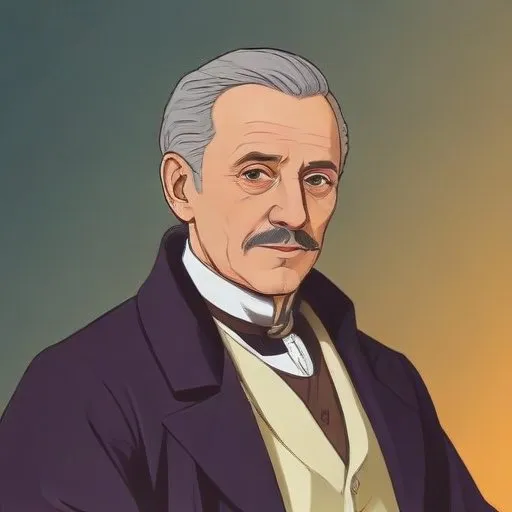
A 17th-century German physician and alchemist who developed the theory of phlogiston, a hypothetical element believed to be responsible for combustion. His work laid the groundwork for modern chemistry.
Johann Joachim Becher was a German physician, alchemist, and polymath who made significant contributions to the development of chemistry, particularly with his phlogiston theory of combustion. He is also renowned for his work in Austrian cameralism, a precursor to modern economics.
Becher was born on May 6, 1635, in Speyer, Germany, during the tumultuous period of the Thirty Years' War. His father, a Lutheran minister, passed away when Becher was just a child, leaving him responsible for supporting his mother and two brothers at the tender age of thirteen.
Despite these challenging circumstances, Becher persevered and developed a passion for learning. He taught himself various handicrafts, studied miscellaneous subjects, and earned a meager income by teaching. This early perseverance laid the foundation for his future accomplishments.
In 1654, at just nineteen years old, Becher published his first significant work, Discurs von der Großmächtigen Philosophischen Universal-Artzney, under the pseudonym Solinus Salzthal of Regiomontus. This treatise on alchemy was later translated into Latin and published in 1659 as Discursus Solini Saltztal Regiomontani De potentissima philosophorum medicina universali, lapis philosophorum trismegistus dicta.
Becher's academic career took off in 1657 when he was appointed professor of medicine at the University of Mainz and physician to the archbishop-elector. His subsequent publications, including Metallurgia (1660) and Character pro notitia linguarum universali (1661), showcased his expertise in metallurgy and his proposal for a universal language.
Becher's phlogiston theory of combustion, developed in the late 1660s, posited that combustible materials contain a fire-like element called phlogiston, which is released during burning. Although this theory was later proven incorrect, it played a significant role in the development of modern chemistry.
Becher's work in alchemy was also rooted in his philosophical beliefs. He believed that alchemy could be used to improve human life and create wealth. His writings on the subject emphasized the importance of experimentation and observation.
Becher's contributions to chemistry and economics have had a lasting impact on modern society. His phlogiston theory, although flawed, paved the way for later scientists like Antoine Lavoisier to develop more accurate understandings of combustion. Additionally, his work in Austrian cameralism influenced the development of modern economics and economic policy.
In 1666, Becher was appointed councillor of commerce (Commerzienrat) at Vienna, marking a significant milestone in his career. He gained the support of Emperor Leopold I's prime minister and was sent on a mission to the Netherlands, where he wrote extensively on various subjects.
Despite his many accomplishments, Becher's life was cut short when he passed away in October 1682, at the age of forty-seven.
Johann Joachim Becher's work and legacy serve as a testament to his innovative spirit and perseverance. He was a true polymath, making significant contributions to multiple fields and leaving an indelible mark on the development of modern chemistry and economics.
In the historical context of the 17th century, Becher's work was instrumental in shaping the course of scientific inquiry and economic thought. His writings and experiments paved the way for later scientists and thinkers, cementing his place as a pioneer in the history of chemistry and alchemy.
Born in 1627
Pioneering scientist who discovered Boyle's Law, which describes the relationship between pressure and volume of gases, and laid foundations for modern chemistry.
Born in 1743
Father of modern chemistry, discovered oxygen, and developed a systematic method of chemical nomenclature. He laid the foundation for modern chemistry and paved the way for future scientific discoveries.
Born in 1668
A Dutch botanist and physician who laid the foundations for modern medicine by emphasizing clinical observation, experimentation, and scientific rigor, and is considered the father of physiology.
