


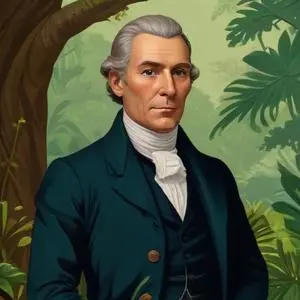
America's first botanist, who explored and cataloged the New World's flora, introducing many species to Europe and establishing a renowned botanical garden. He's considered the "Father of American Botany".
John Bartram, a renowned American botanist, horticulturist, and explorer, is best known for establishing the first botanic garden in the United States, Bartram's Garden, in 1728. This pioneering effort earned him the recognition of Swedish botanist and taxonomist Carl Linnaeus, who dubbed Bartram the "greatest natural botanist in the world."
Bartram was born on March 23, 1699, into a Quaker farm family in colonial Marple, Pennsylvania, near Philadelphia. Despite having no formal education beyond local schooling, he developed a keen interest in medicine and medicinal plants, which would shape his future endeavors. His autodidactic nature led him to read widely, laying the foundation for his botanical career.
Bartram's fascination with plants led him to dedicate a portion of his farm to growing unusual species. This humble beginning soon evolved into a thriving business as he connected with European botanists and gardeners interested in North American plants. His correspondence with Peter Collinson, Alexander Catcott, and others in London facilitated the exchange of plants, seeds, and knowledge, cementing his reputation as a leading authority on American botany.
Between 1737 and 1738, Bartram embarked on an extensive journey through the Mid-Atlantic Colonies, riding horseback through Delaware, Maryland, and Northampton County, Virginia. This expedition allowed him to collect and study numerous plant species, which he would later share with his European counterparts. His travels not only expanded our understanding of American flora but also forged lasting relationships with like-minded individuals across the Atlantic.
Bartram's Garden, now a National Historic Landmark, continues to thrive in partnership with the city of Philadelphia and a non-profit foundation. This living testament to his legacy serves as a beacon for sustainable horticulture and environmental stewardship. As a pioneer in American botany, Bartram's contributions have inspired generations of botanists, horticulturists, and naturalists, earning him a permanent place in the annals of scientific history.
While Bartram's contemporaries, such as John Wesley, were making significant contributions to fields like theology and social justice, Bartram's focus on botany and horticulture set him apart as a pioneer in the scientific community. His dedication to the study and preservation of American plant species has left an indelible mark on the scientific landscape, earning him a unique place among his peers.
John Bartram's remarkable story serves as a testament to the power of passion and dedication. From humble beginnings to international recognition, his journey inspires us to pursue our interests, no matter how unconventional they may seem. As we strive to protect our planet's biodiversity, Bartram's legacy reminds us of the importance of preserving and sharing knowledge for the greater good.
Born in 1707
Developed the system of binomial nomenclature, which is still used today to classify and name living organisms. This system has had a profound impact on the fields of biology, ecology, and conservation.
Born in 1706
A founding father of the United States, he was a leading figure in the Enlightenment, known for his groundbreaking inventions, scientific discoveries, and influential writings. He played a key role in shaping American history and politics.
Born in 1743
The principal author of the Declaration of Independence and a strong advocate for individual liberties and limited government, shaping America's foundational principles. He oversaw the Louisiana Purchase, doubling the country's territory.
Born in 1774
Led the Corps of Discovery expedition with William Clark, mapping the western United States and establishing trade with Native American tribes. Known for his bravery, leadership, and contributions to American exploration and expansion.
75 Years Old
A renowned blues harmonica virtuoso, known for his soulful, expressive playing style and influential recordings that helped shape the sound of Chicago blues.
Born in 1766
A pioneering figure in American ornithology, credited with creating the first comprehensive guide to North American birds, featuring his own illustrations. His work remains a foundation for modern bird studies.
Born in 1785
A pioneering ornithologist and artist, famous for meticulously illustrating and documenting North American bird species in his iconic book "The Birds of America". His work remains a cornerstone of ornithology and wildlife art.
Born in 1810
A pioneering botanist who contributed significantly to the development of American botany, particularly in the fields of plant classification and evolution.
