


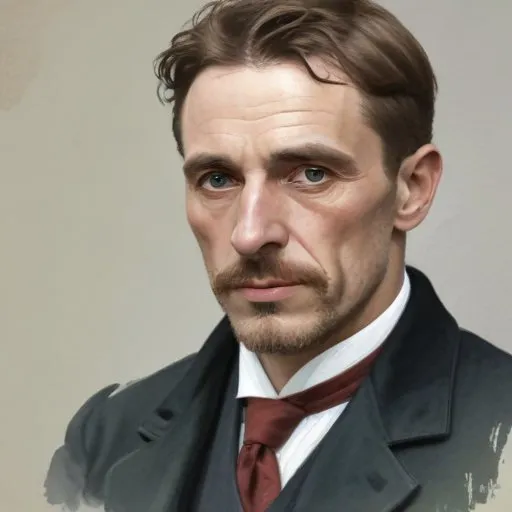
A talented Irish painter, he's renowned for his expressive portraits and landscapes that capture the essence of Irish identity. His artistic style blended realism with a touch of romanticism.
John Butler Yeats, a renowned Irish artist, is celebrated for his mesmerizing portraits that capture the essence of his subjects with remarkable sensitivity. His masterpieces, including the iconic portrait of his son, William Butler Yeats, and John O'Leary, have earned him a permanent place in the art world.
Born on March 16, 1839, in Lawrencetown, County Down, Ireland, John Butler Yeats was the eldest of nine children to William Butler Yeats and Jane Grace Corbet. Growing up in a family that valued education and creativity, Yeats was encouraged to explore his artistic side from a young age.
After completing his education at Trinity College, Dublin, Yeats embarked on a career in law, devilling briefly with Isaac Butt. However, his true calling lay in art, and in 1867, he abandoned law to pursue painting. He honed his skills at the Heatherley School of Fine Art, where he developed his unique style that would eventually gain him recognition.
Yeats' artistic journey took him to England and America, where he created numerous portraits that are now scattered across private collections. His subjects ranged from politicians to artists, and his ability to capture their essence earned him a reputation as a master portraitist. The National Gallery of Ireland proudly holds several of his works, including his portrait of William Butler Yeats, painted in 1900.
In 1907, at the age of 68, Yeats travelled to New York, where he was drawn to the avant-garde artistic movement of the Ashcan School. He befriended artists like Robert Henri and George Luks, who shared his passion for capturing the raw energy of urban life.
Despite his artistic success, Yeats struggled financially throughout his life. He was a poor businessman and had to move frequently, often between England and Ireland, to make ends meet. His later years were marred by financial insecurity, but his artistic flame continued to burn bright.
John Butler Yeats' legacy extends far beyond his own artistic accomplishments. He was a mentor to his children, William, Lily, and Jack, all of whom went on to become prominent artists and writers in their own right. His influence can be seen in the works of the Ashcan School, and his portraits continue to inspire artists to this day.
John Butler Yeats' life was a testament to his passion for art and his ability to capture the essence of those around him. His portraits continue to inspire and delight, ensuring his legacy as one of Ireland's most beloved artists.
Born in 1865
A renowned Irish wordsmith and dramatist, celebrated for his mystical and nationalistic verse that explores the human condition, as well as his contributions to the Irish Literary Revival.
Born in 1866
Irish nationalist and political activist who fought for Irish independence and women's rights, inspiring generations of activists and writers.
Born in 1854
A witty and flamboyant literary mastermind, renowned for crafting clever, humorous, and poignant works that continue to delight audiences with their clever wordplay and societal commentary.
Born in 1856
A renowned Irish playwright and critic, known for his witty, thought-provoking plays that often challenged social norms and conventions. His works include Pygmalion and My Fair Lady.
Born in 1879
Irish revolutionary leader who sparked the Easter Rising, a pivotal event in Ireland's struggle for independence. He's remembered for his bravery and poetic writings.
