


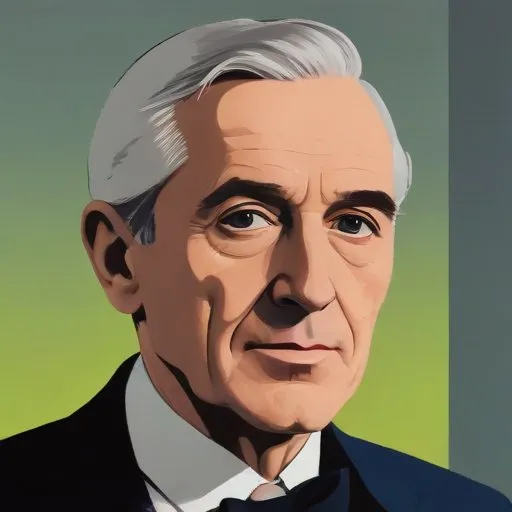
Designed Gothic Revival churches and buildings in England, particularly in Cheshire, with a focus on restoring medieval architecture. His work preserved historical accuracy and aesthetic appeal.
John Douglas, a renowned English architect, is celebrated for designing over 500 buildings in Cheshire, North Wales, and northwest England, leaving an indelible mark on the region's architectural landscape. His works, characterized by an eclectic style that blended Gothic Revival, European influences, and vernacular elements, continue to inspire awe and admiration.
Born on April 11, 1830, in Park Cottage, Lancaster, Douglas began his architectural journey as a pupil in Lancaster, where he honed his skills under the guidance of local architects. This foundation laid the groundwork for his future success, as he would go on to establish his own practice in Chester, which remained his base of operations throughout his career.
Douglas's architectural style was a masterful blend of various influences, reflecting his exposure to diverse cultural and historical contexts. His works incorporated elements of English Gothic, French, German, and Dutch architectural styles, while also drawing inspiration from the region's vernacular traditions. This unique approach earned him recognition for his innovative use of materials, such as halftimbering, tilehanging, pargeting, and decorative brick in diapering, which became a hallmark of his designs.
Douglas's prolific career was marked by a wide range of commissions, from new churches and restorations to country houses, schools, and public buildings. His most celebrated works include the iconic Eastgate Clock in Chester, which has become a symbol of the city, and the numerous buildings he designed for the Grosvenor family of Eaton Hall, particularly in the estate and surrounding villages of Eccleston, Aldford, and Pulford.
Douglas's architectural legacy extends beyond his individual works, as his designs have had a profound impact on the region's cultural and historical identity. His incorporation of vernacular elements and use of local materials helped to promote a sense of regional distinctiveness, while his eclectic style continues to inspire architects, designers, and enthusiasts today.
In 1884, Douglas formed a partnership with two of his former assistants, which lasted until two years before his death in 1911. This period witnessed some of his most notable collaborations, including the design of several country houses and schools.
Douglas's architectural philosophy was rooted in a deep appreciation for the region's cultural heritage and a commitment to creating buildings that were both functional and aesthetically pleasing. His use of local materials and incorporation of vernacular elements reflect his belief in the importance of contextual design, which continues to influence architects and designers today.
John Douglas's remarkable career spanned over five decades, during which he made a profound impact on the region's architectural landscape. His works, characterized by their eclectic style and use of local materials, continue to inspire appreciation and admiration, cementing his legacy as one of the most important architects of his time.
Through his designs, Douglas not only reflected the cultural and historical context of his era but also contributed to the shaping of the region's identity, leaving behind a lasting legacy that continues to inspire future generations of architects, designers, and enthusiasts.
Born in 1815
Developed Boolean logic, a system of algebraic notation for logical operations that laid the foundation for modern computer science and electronic communication.
Born in 1545
A 16th-century Scottish theologian and scholar who played a key role in the Scottish Reformation and was a strong advocate for Presbyterianism. He's known for his debates with King James VI of Scotland and his contributions to the development of the Presbyterian Church of Scotland.
Born in 1430
King of Scotland from 1437 to 1460, known for his efforts to centralize power and his conflicts with the powerful noble families. He was also a patron of the arts and education.
