


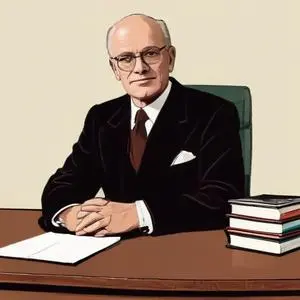
A renowned English novelist and playwright, best known for his insightful portrayals of the British upper class and social commentary, particularly in his series "The Forsyte Saga".
John Galsworthy, the renowned English novelist and playwright, is best known for his trilogy of novels collectively called The Forsyte Saga, which has captivated readers and audiences for generations. His works are a testament to his unwavering commitment to exploring the intricacies of the human condition, and his ability to craft intricate narratives that continue to resonate with us today.
Born on August 14, 1867, into a prosperous upper-middle-class family, Galsworthy was destined for a career in law. However, he found it uncongenial and turned to writing instead. His first book, published in 1897, marked the beginning of a prolific career that spanned nearly four decades.
As a dramatist, Galsworthy became known for plays that tackled pressing social issues of his time, including the struggle of workers against exploitation, the use of solitary confinement in prisons, and the repression of women. His plays, such as The Silver Box, were staged in London and met with critical acclaim.
Galsworthy's magnum opus, The Forsyte Chronicles, is a series of novels and short stories that follows the lives of the Forsyte family from the late 19th century to the early 1930s. The trilogy, comprising The Man of Property, Indian Summer of a Forsyte, and In Chancery, is a sweeping narrative that explores the complexities of family relationships, love, and social class.
The Forsyte family, modeled on Galsworthy's own family, is a microcosm of the English upper-middle class of the time. The patriarch, Old Jolyon, is an enigmatic figure, haunted by the ghosts of his past, while his children and grandchildren grapple with the challenges of modernity and social change.
Galsworthy's contributions to literature were recognized with the 1932 Nobel Prize in Literature, a testament to his enduring impact on the literary world. His works have been widely translated and adapted, and continue to be celebrated for their nuanced exploration of the human experience.
Beyond his literary pursuits, Galsworthy was a tireless advocate for social justice and reform. He campaigned for a range of causes, including animal welfare, prison reform, and workers' rights. His plays and novels often tackled controversial themes, reflecting his commitment to challenging the status quo and promoting social change.
Galsworthy's legacy extends far beyond his literary works. He was a champion of social progress, and his writings continue to inspire generations of readers and writers.
Galsworthy's life was a testament to his unwavering commitment to his craft and his principles. Through his writings, he continues to inspire us to engage with the complexities of the human experience, and to strive for a more just and compassionate world.
John Galsworthy's works continue to be widely read and studied, and his influence can be seen in the many authors who have followed in his footsteps. His legacy extends beyond literature, too, inspiring social change and promoting a deeper understanding of the human condition.
As we reflect on Galsworthy's life and works, we are reminded of the power of literature to transform and to inspire. His writings continue to captivate us, challenging us to confront the complexities of our own lives and to strive for a better world.
Born in 1857
A Polish-born British novelist who wrote thought-provoking and psychologically complex stories that explored the human condition, often set against the backdrop of colonialism and the sea.
Born in 1879
This celebrated author crafted novels and plays that probed the human condition, exploring themes of social class, morality, and personal relationships, with a distinctive wit and insight. Their works continue to captivate audiences with their nuanced portrayals of English society during the early 20th century.
Born in 1885
A pioneering writer of the early 20th century, known for exploring themes of human nature, relationships, and the clash between individual desire and societal expectations through novels like "Sons and Lovers" and "Lady Chatterley's Lover".
Born in 1882
A pioneering author of modernist literature, known for experimental novels and essays that explored the human experience, blurring the lines between reality and fiction.
Born in 1885
A pioneering modernist poet and critic who transformed 20th-century literature with innovative styles and provocative ideas, shaping the course of modern poetry.
Born in 1873
A pioneering modernist writer, credited with influencing 20th-century literature through experimental novels and poetry that explored the human condition. Known for his impressionistic style and complex characters.
Born in 1866
A visionary writer who pioneered the science fiction genre, crafting timeless classics like "The Time Machine" and "War of the Worlds" that continue to inspire and captivate audiences today.
Born in 1867
A prolific writer of novels and plays, known for his realistic portrayals of life in the Staffordshire Potteries and his influence on the development of modern English literature.
