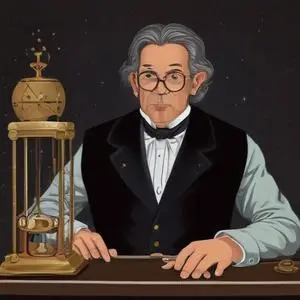
John Harrison: The Pioneer of Precision Timekeeping
The Solution to a centuries-old problem
John Harrison, a skilled English carpenter and clockmaker, revolutionized navigation and maritime history with his invention of the marine chronometer, a device that accurately calculated longitude at sea. This groundbreaking innovation earned him a place among the most celebrated figures in history, solving a problem that had puzzled navigators and scientists for centuries.
A Childhood Fascination with Timekeeping
Born on April 3, 1693, in Foulby, West Riding of Yorkshire, Harrison's fascination with timekeeping began at a young age. According to legend, at the age of six, while recovering from smallpox, he was given a watch to amuse himself, and he spent hours listening to its ticking mechanism and studying its moving parts. This early fascination would lay the foundation for his future achievements.
The Quest for Longitude
The problem of calculating longitude at sea had been a thorn in the side of mariners and explorers for centuries. The inability to accurately determine a ship's longitude led to numerous naval disasters, including the infamous Scilly naval disaster of 1707. In response, the British Parliament passed the Longitude Act of 1714, offering a reward of up to £20,000 (approximately £3.97 million in 2024) for a solution to this pressing problem.
A lifetime of Innovation
Harrison presented his first design for a marine chronometer in 1730 and spent the next several decades refining his ideas. He made significant advances in timekeeping technology, ultimately developing the concept of "sea watches." His innovative designs earned him the support of the Longitude Board, which provided funding for the construction and testing of his chronometers.
The Triumph of H-4
Harrison's most notable achievement was the creation of H-4, a marine chronometer that proved its accuracy on a voyage to Jamaica in 1761. This remarkable device was able to keep accurate time at sea, allowing sailors to calculate their longitude with unprecedented precision. H-4's success marked a major turning point in the history of navigation, greatly increasing the safety of long-distance sea travel.
Recognition and Legacy
Despite facing opposition and skepticism from some quarters, Harrison's work eventually earned him recognition and a reward from Parliament. He was hailed as a hero and a pioneer, and his legacy continued to inspire generations of clockmakers and navigators. In 2002, Harrison was voted the 39th greatest Briton in a BBC poll.
Awards and Honors
- Longitude Act reward (portion of £20,000)
- Recognition from the British Parliament
- Voted 39th greatest Briton in the BBC's 2002 poll
Personal Life and Milestones
- Born on April 3, 1693, in Foulby, West Riding of Yorkshire
- Moved to Barrow upon Humber, Lincolnshire, around 1700
- Became choirmaster for the Church of Holy Trinity, Barrow upon Humber
- Built his first longcase clock in 1713, at the age of 20
A Lasting Impact on History
John Harrison's groundbreaking invention of the marine chronometer revolutionized navigation, opening up new possibilities for exploration and trade. His legacy continues to inspire awe and admiration, a testament to the power of human ingenuity and innovation.
FAQ
What was John Harrisons invention that revolutionized navigation?
John Harrison invented the marine chronometer, a highly accurate clock that enabled sailors to calculate their longitude at sea, revolutionizing navigation and transforming the maritime industry.
How did John Harrisons clocks improve navigation accuracy?
John Harrisons clocks improved navigation accuracy by providing a reliable and accurate way to determine longitude, reducing the risk of navigational errors and improving the safety of sailors.
What were the challenges John Harrison faced in developing his marine chronometer?
John Harrison faced significant challenges in developing his marine chronometer, including procuring funding, overcoming technical difficulties, and persuading the British Navy to adopt his invention.
How did John Harrisons marine chronometer impact the British Navy?
John Harrisons marine chronometer had a profound impact on the British Navy, enabling them to navigate more accurately and efficiently, and giving them a significant advantage over their rivals.
What is John Harrisons legacy in modern times?
John Harrisons legacy in modern times is that of a pioneering inventor and clockmaker who transformed navigation and paved the way for modern technologies such as GPS.