


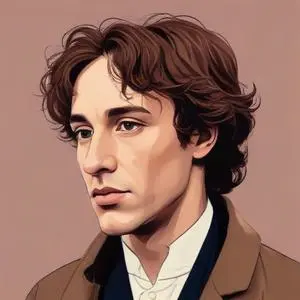
Romantic poet celebrated for sensual language and vivid imagery, capturing the beauty of nature and human experience in odes like "To Autumn" and "Ode to a Nightingale".
John Keats is renowned for his vivid and sensual poetry, which has captivated readers for centuries. As a leading figure of the second generation of Romantic poets, alongside Lord Byron and Percy Bysshe Shelley, Keats' works are characterized by their emphasis on natural imagery, extreme emotions, and exquisite language.
Born on October 31, 1795, in Moorgate, London, John Keats was the eldest of four surviving children to Thomas and Frances Keats (née Jennings). His family lived at the Swan and Hoop Inn, where his father worked as an ostler, and later managed the establishment. Keats' humble origins had a profound impact on his writing, which often reflected his sensitivity to the beauty and hardships of life.
Keats' poetry is distinguished by its rich, sensual language, which evokes a deep sense of emotion and connection with nature. His most celebrated works include:
Keats' poetry is infused with a deep sense of empathy and a profound appreciation for the beauty of the natural world. He believed that the poet's role was to capture the essence of life and to convey the intensity of human emotions. Keats' philosophical contributions lie in his ability to distill the complexities of human experience into exquisite, sensual language.
Keats' poetry has had a lasting impact on literature and art. His emphasis on natural imagery and extreme emotions has influenced generations of writers, including the Pre-Raphaelite Brotherhood. Today, his poems and letters remain among the most popular and analyzed in English literature.
Keats' life was marked by personal struggles and tragedy. He suffered from tuberculosis, which ultimately claimed his life at the age of 25. Despite his short career, Keats produced a remarkable body of work, which continues to inspire and captivate readers to this day.
Keats' poetry is replete with memorable phrases and quotes, including:
Keats' legacy extends far beyond his own lifetime. He has inspired countless writers, artists, and thinkers, including Jorge Luis Borges, who cited Keats as a profound influence. Today, Keats' poetry remains an integral part of the English literary canon, continues to inspire new generations of readers and writers alike.
Born in 1788
Romantic poet and playwright celebrated for passionate, expressive works that explored themes of love, freedom, and the human condition.
Born in 1792
Romantic-era writer of lyrical poetry and Gothic dramas that explored the human condition, freedom, and the beauty of nature.
Born in 1797
Author of Gothic novels, particularly the iconic "Frankenstein", which has become a cultural phenomenon and influenced countless adaptations and reinterpretations.
Born in 1770
A major Romantic poet, known for his focus on nature, emotion, and the human experience, creating works that evoke a sense of wonder and connection to the natural world.
Born in 1772
A leading figure of the Romantic movement, he crafted vivid, imaginative poetry and explored the human experience through his writing and philosophical ideas. His works continue to inspire and influence literature and art to this day.
Born in 1775
A celebrated author of witty, romantic novels of manners that offer insightful commentary on 19th-century English society, particularly the lives of women. Her works remain beloved for their strong female characters, clever dialogue, and nuanced exploration of relationships.
Born in 1818
Wrote classic novels and poetry that explored the human experience, particularly in the context of love, family, and the natural world.
Born in 1816
Author of classic novels like Jane Eyre, exploring themes of love, identity, and social class in 19th-century England. Her works remain beloved for their strong female protagonists and gothic atmosphere.
