


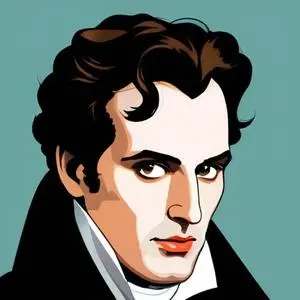
Romantic poet and playwright celebrated for passionate, expressive works that explored themes of love, freedom, and the human condition.
George Gordon Byron, 6th Baron Byron, is renowned as one of the greatest English poets of all time, mesmerizing readers with his lyrical verses and fiery passion. His iconic works, such as Don Juan and Childe Harold's Pilgrimage, have left an indelible mark on literature, solidifying his position as a leading figure of the Romantic movement.
Born on January 22, 1788, in London, England, Byron's life was a tumultuous mix of love, loss, and liberation. His early years were marked by a troubled relationship with his mother, Catherine Gordon, and a Clubfoot that would haunt him throughout his life. Despite these challenges, Byron's fiery spirit and passion for life propelled him into the world of poetry, politics, and eventually, war.
Byron's academic journey began at Trinity College, Cambridge, where he developed a strong affinity for classical literature and poetry. Following his studies, he embarked on a grand tour of Europe, visiting Portugal, Spain, and Greece, which would later inspire some of his most celebrated works. His European sojourns also involved romantic conquests, scandals, and debt, further fueling the Byronic legend.
Byron's personal life was a labyrinth of passionate love affairs, scandals, and illegitimate children. His marriage to Anne Isabella Milbanke produced a daughter, Ada Lovelace, a pioneering figure in computer science. He also had several extramarital children, including Allegra Byron and possibly Elizabeth Medora Leigh. His tumultuous relationships and risqué behavior only added to his notoriety, cementing his status as a true original.
In 1823, Byron joined the Greek War of Independence, fighting against the Ottoman Empire. His bravery and military prowess earned him the respect and admiration of the Greek people, who revered him as a folk hero. Tragically, Byron's life was cut short during the siege of Missolonghi in 1824, when he succumbed to a fever at the age of 36.
Byron's contribution to literature is immeasurable, inspiring generations of writers, poets, and artists. His works have been translated into numerous languages, and his influence can be seen in the Romantic movement, Victorian literature, and even modern pop culture. His rebellious spirit, passion for life, and literary genius have solidified his place in the pantheon of literary greats.
Byron's philosophy was deeply rooted in the values of the Romantic era, emphasizing the importance of individualism, freedom, and the beauty of nature. He believed in the power of passion and emotion, often expressing his thoughts through his poetry. His commitment to the Greek War of Independence demonstrated his dedication to the cause of liberty and democracy.
A visual representation of Byron's life, highlighting key events, works, and milestones:
| 1788 | Birth in London, England |
| 1805 | Enrolled at Trinity College, Cambridge |
| 1809 | Grand tour of Europe |
| 1812 | Publication of Childe Harold's Pilgrimage |
| 1816 | Exile in Italy |
| 1823 | Joined the Greek War of Independence |
| 1824 | Death during the siege of Missolonghi |
Lord Byron's life was a testament to the power of creativity, passion, and individuality. His legacy continues to inspire and captivate readers to this day, solidifying his position as one of the greatest literary figures of all time.
Born in 1792
Romantic-era writer of lyrical poetry and Gothic dramas that explored the human condition, freedom, and the beauty of nature.
Born in 1795
Romantic poet celebrated for sensual language and vivid imagery, capturing the beauty of nature and human experience in odes like "To Autumn" and "Ode to a Nightingale".
Born in 1797
Author of Gothic novels, particularly the iconic "Frankenstein", which has become a cultural phenomenon and influenced countless adaptations and reinterpretations.
Born in 1749
A German literary giant who penned iconic works like "Faust" and "The Sorrows of Young Werther", shaping the Romantic movement and influencing countless writers.
Born in 1608
Wrote epic poems, including "Paradise Lost", that explored themes of morality, free will, and the human condition.
Born in 1770
A major Romantic poet, known for his focus on nature, emotion, and the human experience, creating works that evoke a sense of wonder and connection to the natural world.
Born in 1772
A leading figure of the Romantic movement, he crafted vivid, imaginative poetry and explored the human experience through his writing and philosophical ideas. His works continue to inspire and influence literature and art to this day.
