


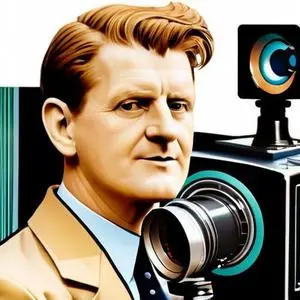
Scottish engineer who pioneered the development of the first publicly demonstrated television system, revolutionizing entertainment and communication.
John Logie Baird, a Scottish inventor and engineer, revolutionized the world of communication by demonstrating the first live, working television system on January 26, 1926. This innovation marked the beginning of a new era in broadcasting, earning Baird a prominent place in television's history.
Born on August 13, 1888, in Helensburgh, Dunbartonshire, Scotland, Baird was the youngest of four children to Reverend John Baird and Jessie Morrison Inglis. He was educated at Larchfield Academy, now part of Lomond School, and later attended the University of Glasgow, where he pursued a degree in engineering.
In the early 1920s, Baird began experimenting with the concept of transmitting images through the airwaves. His dedication and perseverance led to the development of the first live, working television system. On January 26, 1926, Baird demonstrated his invention to the public for the first time, transmitting live, monochrome images of a ventriloquist's dummy called Stooky Bill.
Baird's contribution to the development of television has been recognized and celebrated throughout his career and beyond. Some of his notable accolades include:
Baird's experiences in industrial Glasgow shaped his socialist convictions, which stayed with him throughout his life. Despite his agnostic views, he maintained a strong relationship with his father, Reverend John Baird.
Baird's invention of television has had a profound impact on modern society, revolutionizing the way people consume information and entertainment. His innovation has enabled global connectivity, shaping the course of human history.
John Logie Baird's groundbreaking achievement in demonstrating the first live, working television system has left an indelible mark on the world. His pioneering spirit, innovative thinking, and tireless pursuit of excellence have inspired generations of inventors, engineers, and scientists. As we continue to navigate the complexities of modern technology, Baird's legacy serves as a reminder of the power of human ingenuity and creativity.
Born in 1874
Developer of the first practical wireless telegraph, pioneering radio communication and earning a Nobel Prize in Physics. Known for revolutionizing long-distance communication.
Born in 1906
Invented the first fully functional all-electronic television system and developed the Fusor, a device that achieves nuclear fusion. He's a pioneer in television technology and plasma physics.
Born in 1873
Invented the Audion tube, a type of vacuum tube that revolutionized radio communication and paved the way for modern electronics. This innovation enabled the amplification of weak electrical signals, transforming the field of communication.
98 Years Old
A Hall of Fame basketball player and coach who led the Boston Celtics to multiple championships in the 1950s and 1960s, known for his dominant rebounding and defensive skills.
Born in 1912
Pioneering mathematician and computer scientist who cracked the German Enigma code during WWII and laid the foundations for modern computer science and artificial intelligence.
71 Years Old
Co-founder of Apple and Pixar, revolutionizing personal computers and animation with innovative designs and storytelling. Leaving a lasting impact on the tech and entertainment industries.
