


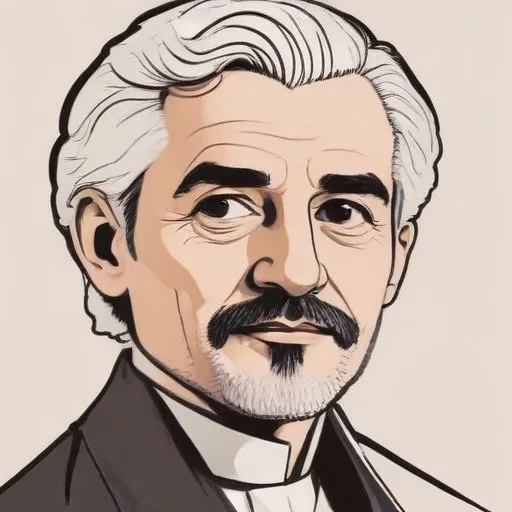
A 19th-century philosopher who focused on metaphysics, ethics, and the nature of reality, leaving a lasting impact on Maltese intellectual history.
John Matthew Rispoli, a 17th-century Maltese philosopher, stands out as one of the most erudite thinkers of his time, earning the esteem of the Grand Masters of the Knights Hospitaller Order, Bishops of Malta, and Viceroys of Sicily. He is renowned for his profound philosophical contributions, which have had a lasting impact on the intellectual landscape of his era.
Rispoli was born on August 17, 1582, in Senglea, Malta, to John Vincent and Catherine. His father's profession as a pilot on one of the galleys of the Knights Hospitaller ensured a decent financial income, enabling Rispoli to receive a good education from an early age.
In 1598, at the age of 16, Rispoli joined the Dominican Order at the Annunciation Priory of Vittoriosa, where he was formally admitted a year later and given the name John Matthew. He was subsequently sent to Palermo, Sicily, to pursue his studies in philosophy and theology at the Dominican Studium Generale.
Rispoli's intellectual prowess was evident in his writings, which showcased his mastery of philosophical concepts and his ability to engage with the intellectual giants of his time. His works demonstrate a deep understanding of Aristotelian philosophy, as well as his own unique insights and perspectives.
His philosophical contributions earned him recognition and respect from his contemporaries, including cardinals, bishops, and inquisitors. Rispoli's intellectual reputation extended beyond Malta, with his works being studied and admired in France and Italy.
Rispoli was an accomplished professor of philosophy, teaching at various institutions of higher education. He was also an able preacher and held administrative posts within the Dominican Order, demonstrating his leadership skills and commitment to his community.
Rispoli was not only a philosopher but also a talented musician, proficient in playing musical instruments. This multifaceted personality adds depth to our understanding of his intellectual and creative pursuits.
Despite his reputation for holiness, Rispoli was not immune to controversy. The Inquisition suspected him of heresy and imprisoned him for 14 months. However, his reputation was ultimately redeemed, and he was given an almost state funeral upon his death in 1639.
John Matthew Rispoli's philosophical legacy continues to inspire and influence thinkers to this day. His commitment to intellectual pursuits, his passion for music, and his unwavering dedication to his faith have left an indelible mark on the history of philosophy.
Born in 1920
Leader of the Catholic Church from 1978 to 2005, known for helping to end communism in Poland and being a charismatic advocate for human rights and social justice.
Born in 1900
A German philosopher and scholar who developed philosophical hermeneutics, a methodology for interpreting texts and understanding human experience, and is known for his work on the importance of language and tradition in shaping our understanding of the world.
Born in 1904
A German priest and theologian who sought to reconcile Catholicism with modern philosophy, exploring the intersection of faith and reason. His work greatly influenced 20th-century Catholic theology.
