


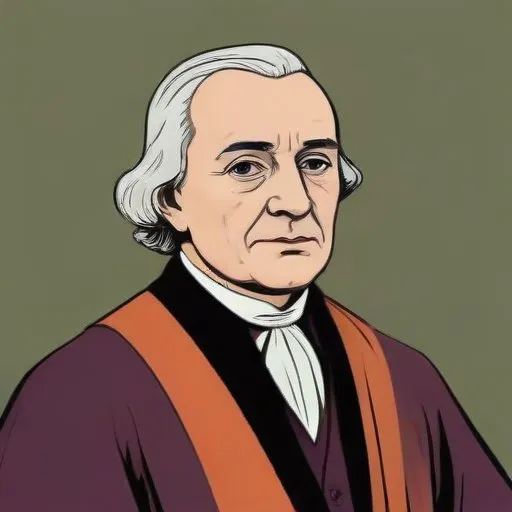
A prominent figure in 17th-century British politics, he played a crucial role in shaping the country's legal and political landscape, particularly during the Glorious Revolution. He's most known for his influential writings on law and politics.
John Somers, 1st Baron Somers, was a prominent English jurist, Whig statesman, and peer who played a pivotal role in shaping the Revolution settlement and ensuring the Protestant succession. He is most renowned for his instrumental involvement in the union between England and Scotland in 1707 and his advocacy for the Exclusion Bill, solidifying his position as one of the leading Whigs of his time.
Born on March 4, 1651, at Claines, near Worcester, Somers was the eldest son of John Somers, an attorney, and Catherine Ceaverne of Shropshire. He received his education at Queen Mary's Grammar School, Walsall, and The King's School, Worcester, before entering Trinity College, Oxford, as a gentleman commoner. Subsequently, he studied law under the tutelage of Sir Francis Winnington, Solicitor-General, and joined the Middle Temple.
Somers' national acclaim began with his involvement in the trial of the Seven Bishops in 1688. As part of the defense counsel, he demonstrated his exceptional legal skills and his commitment to the principles of justice and religious freedom. This significant milestone in his career marked the beginning of his ascendance as a leading Whig statesman.
Somers was an ardent advocate for the Exclusion Bill, publishing tracts that elaborated his Whig principles in support of the Exclusionists. His written works, including "A Brief History of the Succession, Collected out of the Records and the Most Authentick Historians" (1680), demonstrated his meticulous research and sound argumentation skills. These writings showcased his conviction that Parliament had the authority to regulate the succession of the English crown, a stance that countered the arguments of those who believed Parliament had no right to alter the succession.
In 1697, Somers was appointed Lord High Chancellor of England under King William III, a position that enabled him to shape the Revolution settlement. He worked tirelessly to ensure the smooth transition of power, navigating complex political landscapes and forging alliances with fellow Whigs. His diplomatic prowess and commitment to the Protestant succession earned him a prominent place in the Whig Junto, a group of four influential Whig politicians who dominated English politics for over two decades.
In 1707, Somers played a crucial role in negotiating the Acts of Union, which united England and Scotland under a single government. This significant achievement cemented his reputation as a master strategist and statesman, capable of navigating the intricacies of international diplomacy and constitutional reform.
John Somers, 1st Baron Somers, left an indelible mark on English history, shaping the course of the Revolution settlement and ensuring the Protestant succession. His commitment to Whig principles, his advocacy for the Exclusion Bill, and his instrumental role in the union between England and Scotland have solidified his position as one of the most influential statesmen of the late 17th and early 18th centuries.
Born in 1650
The Prince of Orange, King of England, Scotland, and Ireland, led the Glorious Revolution, overthrowing the Catholic King James II, and ruled with his wife Mary II, establishing a Protestant monarchy. He's also known for his military victories in Ireland and Europe.
Born in 1516
The first queen to rule England in her own right, Bloody Mary tried to restore Catholicism, earning her notorious reputation for burning hundreds of Protestants at the stake.
Born in 1676
The first Prime Minister of the United Kingdom, serving from 1721 to 1742, known for establishing the office of Prime Minister and setting important precedents for the role. He is also recognized for his skill in managing Parliament and his role in shaping British politics.
55 Years Old
Australian rules football legend who played 137 games and coached three teams, including the Melbourne Football Club, leading them to a premiership in 1964.
