


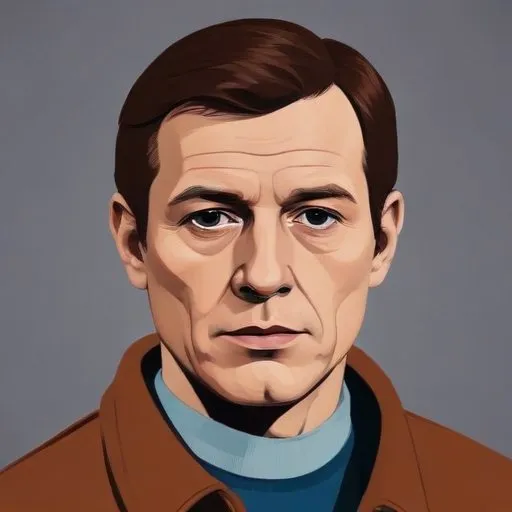
Notorious for being the first person to be executed in the electric chair after the reintroduction of capital punishment in the United States in 1977, sparking controversy and debate about the death penalty.
John Spenkelink, a name etched in the annals of American criminal history, is notorious for being the first person to be executed in Florida after capital punishment was reinstated in 1976, and the second in the United States after Gary Gilmore.
Spenkelink's life was marked by turmoil from a young age. At just 12 years old, he discovered his father's lifeless body in his truck, a victim of carbon monoxide poisoning. This traumatic event set the tone for a tumultuous youth, marked by multiple arrests and stints in various jails and reform schools.
Spenkelink's descent into criminality began in his late teenage years. At 18, he married, but his life was soon marred by a string of armed robberies, culminating in a five-year-to-life sentence in a California prison. However, in 1972, Spenkelink escaped from prison, fleeing to Florida, where he embarked on a new crime spree.
On February 4, 1973, Spenkelink picked up hitchhiker Joseph J. Szymankiewicz in Tallahassee, Florida. The two embarked on a robbery spree, but their partnership was short-lived. Following a heated argument, Spenkelink shot Szymankiewicz in the back and bludgeoned him with a hatchet. Less than a week later, Spenkelink was arrested in Buena Park, California, and the murder weapon was discovered in an associate's apartment.
Spenkelink claimed he acted in self-defense, alleging that Szymankiewicz had stolen his money, forced him to play Russian roulette, and sexually assaulted him. However, the jury remained unconvinced, and Spenkelink was found guilty of first-degree murder, earning him a death sentence. His codefendant, Frank Brumm, was acquitted, but later revealed that Spenkelink had offered him $1,000 to eliminate a friend, and that they had both shot and beaten Szymankiewicz.
In 1979, Spenkelink's fate was sealed. He became the first person to be executed in Florida since 1964, and the second in the United States after Gary Gilmore. His execution sparked controversy, with many questioning the reinstatement of capital punishment.
John Spenkelink's story serves as a stark reminder of the consequences of a life of crime. His execution marked a turning point in the national conversation surrounding capital punishment, sparking debates that continue to this day.
79 Years Old
Notorious serial killer who confessed to 30 murders, mostly of young women, during the 1970s, known for his charismatic persona and evasion of capture for years.
Born in 1865
A pioneering Australian writer and activist who championed workers' rights and women's suffrage through her powerful poetry and journalism.
84 Years Old
Notorious serial killer and rapist who terrorized Chicago in the 1970s, murdering at least 33 young men and boys, often targeting vulnerable individuals.
73 Years Old
Notorious serial killer and arsonist who terrorized New York City in the 1970s, killing six people and injuring seven others, earning the nickname "Son of Sam."
66 Years Old
Notorious serial killer and sex offender who terrorized California in the 1980s, committing heinous crimes that shocked the nation. Known for his brutal and satanic rituals.
66 Years Old
Notorious serial killer who committed heinous murders and engaged in necrophilia and cannibalism, shocking the nation with his depraved crimes.
94 Years Old
Notorious serial killer behind the brutal murders of 11 women in Boston during the 1960s, earning the moniker "The Boston Strangler" through his heinous crimes.
87 Years Old
Notorious for a 1950s killing spree across the American Midwest, leaving 11 victims in their wake, this teenage outlaw's brutal crimes shocked the nation.
