


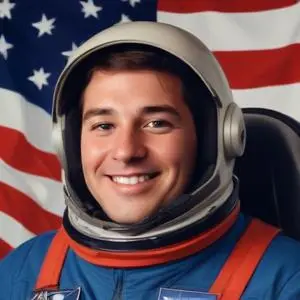
A pioneering astronaut and commander of the first Space Shuttle mission, known for walking on the Moon during the Apollo 16 mission. He also held the record for most spaceflights by an individual until 2002.
John W. Young is renowned for being the ninth person to walk on the Moon and the only astronaut to fly on four different classes of spacecraft: Gemini, Apollo command and service module, Apollo Lunar Module, and the Space Shuttle. His extraordinary career spanned over four decades, leaving an indelible mark on the annals of space exploration.
John Watts Young was born on September 24, 1930, at St. Luke's Hospital in San Francisco, California, to William Hugh Young, a civil engineer, and Wanda Young (née Howland). He grew up with a passion for flight, which led him to pursue a Bachelor of Science degree in Aeronautical Engineering from the Georgia Institute of Technology.
After graduating, Young joined the U.S. Navy, serving at sea during the Korean War. He later became a naval aviator and graduated from the U.S. Naval Test Pilot School. As a test pilot, he set several world time-to-climb records, solidifying his reputation as a skilled and fearless aviator.
In 1962, Young was selected as a member of NASA Astronaut Group 2. He flew on the first crewed Gemini mission, Gemini 3, in 1965, and then commanded the 1966 Gemini 10 mission. In 1969, he flew as command module pilot on Apollo 10, becoming the first person to orbit the Moon alone.
In 1972, Young commanded Apollo 16, spending three days on the lunar surface exploring the Descartes Highlands with Charles Duke. This mission marked a significant milestone in space exploration, as it was the first scientific expedition to the Moon's highlands.
Young also commanded STS-1 in 1981, the Space Shuttle program's first launch, and STS-9 in 1983, both on the Columbia spacecraft. He was one of only two astronauts to fly on both an Apollo mission and a Space Shuttle mission, and the only astronaut to walk on the Moon and fly on the Space Shuttle.
Young served as Chief of the Astronaut Office from 1974 to 1987, playing a pivotal role in shaping the astronaut corps. He retired from NASA in 2004, after 42 years of service, leaving behind a legacy of innovation, bravery, and dedication to the pursuit of space exploration.
John W. Young's extraordinary life and achievements serve as a testament to human ingenuity, perseverance, and the boundless potential of the human spirit. His contributions to space exploration have inspired generations, and his legacy will continue to propel us toward the stars.
95 Years Old
First person to walk on the Moon during the Apollo 11 mission, marking a historic milestone in space exploration.
96 Years Old
Second man to walk on the Moon during the Apollo 11 mission, a pioneering astronaut and advocate for space exploration.
96 Years Old
Led the third manned mission to land on the Moon, Apollo 12, and became the third person to walk on its surface. Known for his bold and fearless approach to space exploration.
94 Years Old
One of the 12 humans to walk on the Moon during NASA's Apollo program, known for his moonwalk during Apollo 12 and later becoming a painter, capturing the beauty of space through art.
98 Years Old
Commander of the Apollo 13 mission, known for his heroic efforts in saving his crew after an explosion occurred on board. He's an iconic figure in space exploration history.
91 Years Old
A geologist-astronaut who walked on the Moon during the Apollo 17 mission and later became a US Senator, known for his scientific contributions and space exploration achievements.
90 Years Old
A decorated military officer who walked on the Moon during the Apollo 16 mission, also holding the distinction of being the youngest person to do so at the time.
