


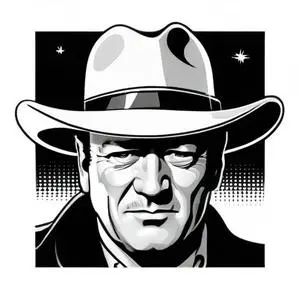
Iconic star of Westerns and war movies, known for his rugged, macho persona and distinctive voice. He embodied American values and ideals on screen.
John Wayne, the one and only "Duke," is an American icon, synonymous with the Wild West and rugged individualism. With a career spanning over five decades, Wayne's name is etched in the annals of Hollywood history, with 179 films and television productions to his credit.
Born Marion Robert Morrison on May 26, 1907, in Winterset, Iowa, Wayne grew up in Southern California. His early life was marked by a love for sports, earning a football scholarship to the University of Southern California (USC). However, a bodysurfing accident cut short his athletic career, and he began working at the Fox Film Corporation, where he started his journey in the film industry.
Wayne's early years in Hollywood were marked by small roles in numerous films. However, his breakthrough came in 1930 with Raoul Walsh's The Big Trail, an early widescreen film epic that, although a box office failure, showcased Wayne's potential as a leading man. Throughout the 1930s, Wayne appeared in numerous B movies, mostly Westerns, slowly building his reputation as a talented actor.
The turning point in Wayne's career came with John Ford's Stagecoach (1939), which catapulted him to mainstream stardom. This marked the beginning of a long and fruitful collaboration with Ford, resulting in some of Wayne's most iconic roles. Wayne went on to star in 142 motion pictures, solidifying his position as one of Hollywood's top box office draws for three decades.
Wayne's impressive filmography boasts some of the most iconic roles in Hollywood history. Who can forget his portrayal of:
Wayne's other notable roles include The Quiet Man (1952) with Maureen O'Hara, Rio Bravo (1959) with Dean Martin, and The Longest Day (1962).
John Wayne's influence on American cinema is immeasurable. He personified the nation's frontier heritage, embodying the values of courage, honor, and loyalty. In 1999, the American Film Institute selected Wayne as one of the greatest male stars of classic American cinema. His legacy continues to inspire new generations of actors, filmmakers, and audiences alike.
Wayne's personal beliefs and values were deeply rooted in American conservatism. He was a vocal supporter of traditional values, patriotism, and individual freedom. His on-screen persona reflected these beliefs, often portraying characters who embodied these ideals.
Wayne's personal life was marked by three marriages and seven children. He was a passionate outdoorsman, enjoying activities like hunting and fishing. Throughout his life, Wayne battled health issues, including lung cancer, and passed away on June 11, 1979, leaving behind a legacy that continues to captivate audiences worldwide.
At the height of his career, Wayne's net worth was estimated to be around $50 million (approximately $350 million today). His films grossed hundreds of millions of dollars, making him one of the highest-paid actors of his time.
John Wayne's impact on modern society extends beyond cinema. He influenced fashion, with his iconic cowboy style still inspiring designers today. His rugged individualism and traditional values continue to resonate with audiences, making him a cultural icon of American masculinity.
Wayne received numerous awards and accolades throughout his career, including:
John Wayne's enduring legacy is a testament to his talent, dedication, and the timeless appeal of his on-screen persona. As "The Duke," he continues to ride tall in the saddle, inspiring new generations to come.
Born in 1894
Acclaimed filmmaker behind iconic Westerns and dramas, credited with shaping the American cinematic landscape with his visually stunning and emotionally charged storytelling.
Born in 1920
A fiery redhead who lit up the silver screen with her striking beauty and captivating performances in classic Hollywood films, especially in Westerns and romantic comedies.
Born in 1910
Academy Award-winning actress renowned for her iconic film noir performances and distinctive voice. She brought depth and nuance to complex, often troubled characters.
Born in 1903
A rugged, versatile actor who brought authenticity to Westerns and dramas, starring in over 200 films and TV shows, including John Ford's classics and "Wagon Train".
Born in 1924
Tough-guy actor famous for rugged, iconic roles in Westerns and war movies, including "The Dirty Dozen" and "Point Blank".
Born in 1917
A legendary entertainer, known for smooth vocals, charming on-screen presence, and iconic Rat Pack performances, leaving a lasting impact on the music and film industries.
Born in 1908
Iconic leading man of Hollywood's Golden Age, starring in classics like "It's a Wonderful Life" and "Rear Window", bringing everyman charm to cinematic legends.
Born in 1905
Iconic actor of Hollywood's Golden Age, starring in classics like "The Grapes of Wrath" and "On Golden Pond", earning him two Oscars and a lifetime of critical acclaim.
