


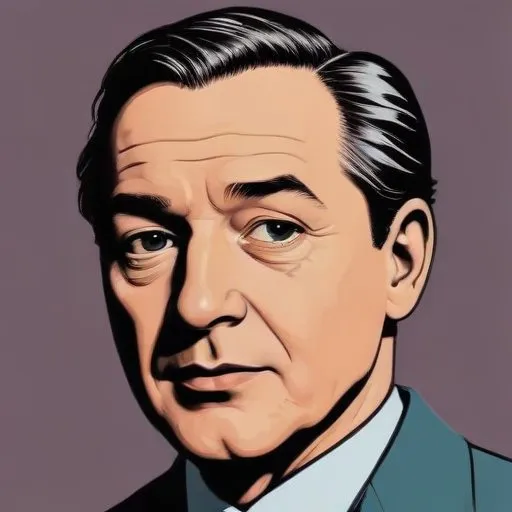
A British science fiction writer, best known for his dystopian novels that explore the consequences of scientific progress and catastrophic events on human society.
John Wyndham, a renowned English science fiction writer, is best known for his captivating works that have left an indelible mark on the literary world. His iconic novels, such as The Day of the Triffids and The Midwich Cuckoos, have been adapted into films and continue to enthrall audiences to this day.
Born on July 10, 1903, in the village of Dorridge, Warwickshire (now West Midlands), England, Wyndham was the son of Gertrude Parkes and George Beynon Harris. His early life was marked by turmoil, with his parents separating when he was just eight years old. This led to a high-profile court case in 1913, which ultimately resulted in Wyndham and his younger brother, Vivian Beynon Harris, becoming estranged from their father.
Wyndham's educational journey took him to various schools, including a private school in Edgbaston, Edgbaston High School for Boys, Blundells School in Tiverton, and finally, Bedales School in Hampshire. He left Bedales at the age of 18, ready to embark on his writing career.
Wyndham's writing career spanned several decades, during which he published numerous novels, short stories, and essays under various pseudonyms, including John Beynon and Lucas Parkes. Some of his most notable works include:
Wyndham's works often explored complex themes, such as the consequences of scientific progress, the dangers of unchecked technological advancement, and the fragility of human society. His writing provided a unique perspective on the world, encouraging readers to question the status quo and contemplate the implications of human actions.
Wyndham's personal life was marked by significant events, including his parents' separation and the court case that followed. He also experienced the challenges of World War I, which had a profound impact on his writing and worldview.
Wyndham married Grace Wilson in 1963, and the couple remained together until his passing on March 11, 1969.
Wyndham's works have had a lasting impact on science fiction and popular culture. His novels have inspired numerous adaptations, including films, television shows, and stage productions. His influence can be seen in the works of authors such as Stephen King, who has cited Wyndham as an inspiration.
Wyndham's legacy continues to captivate audiences, with his works remaining relevant in today's world. His exploration of complex themes and thought-provoking ideas has cemented his place as one of the most important science fiction writers of the 20th century.
"When a day that you happen to know is Wednesday starts off by sounding like Sunday, there is something seriously wrong somewhere." - John Wyndham, The Day of the Triffids
Wyndham's life and work are a testament to his boundless creativity and imagination. His writing continues to inspire and captivate audiences, ensuring his legacy as a master of science fiction endures.
Born in 1866
A visionary writer who pioneered the science fiction genre, crafting timeless classics like "The Time Machine" and "War of the Worlds" that continue to inspire and captivate audiences today.
Born in 1828
A visionary writer who pioneered the science fiction genre, crafting timeless tales of adventure and exploration that continue to inspire generations.
Born in 1917
Pioneering science fiction author who wrote prophetic and imaginative novels, such as "2001: A Space Odyssey", that explored the intersection of technology and humanity.
Born in 1920
A renowned science fiction author and biochemistry professor who wrote or edited more than 500 books and an estimated 90,000 letters and postcards throughout his lifetime.
Born in 1920
Prolific author of poetic and imaginative science fiction, exploring the human condition through fantastical worlds and characters, with works adapted into films and TV shows.
Born in 1907
Pioneering science fiction author and screenwriter who penned influential classics like "Stranger in a Strange Land" and "Starship Troopers", exploring complex social and philosophical themes.
Born in 1919
Pioneering science fiction author and journalist, known for exploring complex social and philosophical themes in his works, including the award-winning novel "Gateway".
Born in 1923
A science fiction author who wrote novels and short stories that often explored the consequences of technological advancements and societal changes, particularly in the 1950s.
