


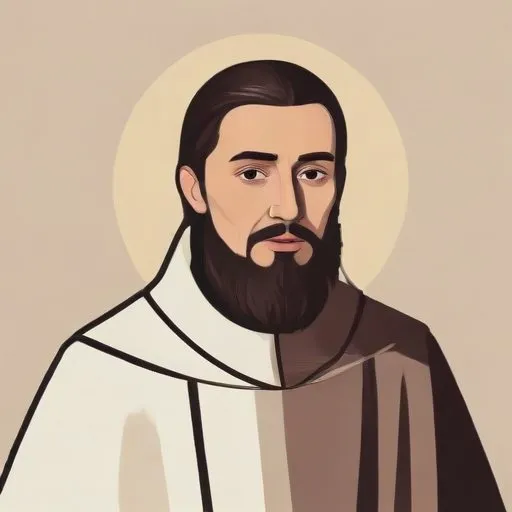
A 16th-century Spanish mystic and saint who wrote influential spiritual works, guiding many on the path to mysticism and spiritual growth.
Renowned for his extensive ministry in Andalusia, John of Ávila is a revered Spanish priest, preacher, and mystic who has been declared a saint and Doctor of the Church by the Catholic Church. Through his remarkable life and works, he has left an indelible mark on the spiritual landscape of Spain and beyond.
Born on January 6, 1499, in Almodóvar del Campo, in the modern-day Province of Ciudad Real, John was the son of Alfonso de Ávila, of Jewish converso descent, and Catalina Xixón or Gijn, a wealthy and pious couple. At the age of fourteen, he was sent to the University of Salamanca to study law, but withdrew in 1517 without receiving a degree.
Returning home, John spent the next three years in austere piety, which impressed a Franciscan friar journeying through Almodóvar. On the friar's advice, John resumed his studies at the University of Alcalá de Henares, where he undertook the study of philosophy and theology under the guidance of the notable Dominican friar, Domingo de Soto.
Ordained in the spring of 1526, John celebrated his first Mass in the church where his parents were buried. He then sold the family property and gave the proceeds to the poor, seeing in this act a vocation to foreign missionary work. He prepared to go to Mexico, but while waiting in Seville, his exceptional devotion in celebrating Mass and his skills in catechesis and preaching attracted attention.
John's preaching resonated deeply with the people of Andalusia, earning him the title of "Apostle of Andalusia." His sermons emphasized the importance of interior reform, and he encouraged his listeners to cultivate a deep sense of devotion and spiritual discipline.
John's theological teachings were deeply rooted in the scholastic tradition, and he was influenced by the works of Thomas Aquinas. He emphasized the importance of reason and faith, and his writings demonstrate a profound understanding of the human condition.
He believed that spiritual growth required a deep understanding of oneself and one's relationship with God. His teachings emphasized the need for self-reflection, prayer, and mortification, and he advocated for a life of simplicity and detachment.
John of Ávila's influence on the Catholic Church has been profound. He was a spiritual director to many prominent figures, including St. Teresa of Ávila, St. John of the Cross, and St. Francis Borgia. His works have inspired countless generations of Catholics, and he has been declared a Doctor of the Church.
Today, John of Ávila is revered as a model of spiritual excellence, and his legacy continues to inspire Catholics around the world. His emphasis on interior reform, self-reflection, and devotion has made him a beloved figure in the history of Catholicism.
John of Ávila's teachings have had a lasting impact on modern Catholicism. His emphasis on spiritual discipline and interior reform has influenced countless generations of Catholics, and his writings continue to inspire spiritual seekers around the world.
His legacy extends beyond the Catholic Church, too. His emphasis on self-reflection, prayer, and devotion has made him a beloved figure in the history of spirituality, and his teachings continue to inspire people of all faiths and backgrounds.
Born in 1515
A 16th-century Spanish mystic and writer who introduced reforms to the Carmelite Order, promoting contemplative prayer and spiritual growth. Her writings are still widely read today.
Born in 1491
Founded the Jesuit Order, a Catholic religious organization known for its missionary and educational work, and developed the Spiritual Exercises, a guide for spiritual growth and discernment.
Born in 1506
Co-founder of the Society of Jesus, a Catholic religious order, known for his missionary work in Asia, especially in India and Japan, and for his role in the Counter-Reformation. He's revered for his tireless efforts to spread Christianity and his compassion for the poor and marginalized.
Born in 1548
A 16th-century Spanish priest, philosopher, and theologian who developed influential concepts in metaphysics, ethics, and law, shaping modern Western philosophy. His works heavily influenced Enlightenment thinkers and the development of international law.
Born in 1542
A 16th-century theologian and doctor of the Church, known for his writings on spirituality and his role in shaping Catholic doctrine. He was a key figure in the Counter-Reformation, defending Catholicism against Protestantism.
