


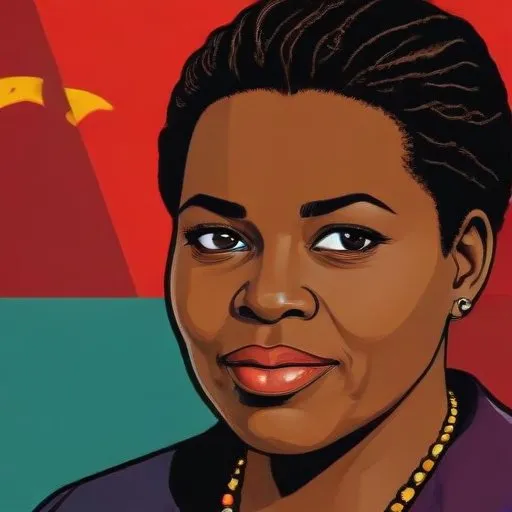
The 3rd President of Angola, a key figure in the country's transition to democracy, known for his efforts to rebuild and stabilize the nation after decades of civil war.
Joo Loureno, the 3rd president of Angola, has been a beacon of hope and transformation for the nation since 2017. As the Chairman of the People's Movement for the Liberation of Angola (MPLA), he has played a pivotal role in shaping the country's political landscape and economic growth.
Born on March 5, 1954, Loureno grew up in a family of ten children, where politics was an integral part of their daily lives. His father, Sequeira Joo Loureno, a doctor and nationalist, was imprisoned for three years for his political activism, instilling in Loureno a strong sense of duty and responsibility towards his nation.
Loureno received his primary and secondary education in Bi Province and Luanda, before studying at the Industrial Institute of Luanda. He later participated in the liberation struggle in Ponta Negra, becoming one of the first MPLA soldiers to enter Angolan territory after the fall of the Portuguese colonial regime.
Loureno's military career spans over four decades, beginning with his fight against the Portuguese in the Angolan War of Independence. He rose through the ranks, becoming the Minister of Defence from 2014 to 2017, before being designated as the MPLA's number one candidate in the August 2017 legislative election.
As the MPLA won a majority of 150 seats, Loureno automatically became the President of Angola, succeeding Jos Eduardo dos Santos, who had been in power for 38 years. He was officially sworn into office on September 26, 2017, marking a new era of growth and development for Angola.
Loureno's leadership is guided by a strong sense of nationalism and a commitment to the principles of democracy. He has stressed the importance of national unity, economic diversification, and infrastructure development, aiming to transform Angola into a regional powerhouse.
Under Loureno's leadership, Angola has witnessed significant economic growth, with a focus on infrastructure development, agriculture, and industrialization. He has also emphasized the importance of education and healthcare, investing heavily in these sectors to improve the lives of Angolans.
Loureno's presidency marks a significant turning point in Angola's history, as the country transitions from a era of authoritarian rule to a more democratic and inclusive system. His leadership is a testament to the country's resilience and capacity for transformation, and his legacy will be remembered for generations to come.
As Angola continues to evolve and grow, Joo Loureno's vision for a unified, prosperous, and democratic nation serves as a beacon of hope for its people, inspiring a new era of development and cooperation in the region.
77 Years Old
The first Portuguese to lead the United Nations, he's a champion of global cooperation, human rights, and sustainable development. He's a prominent voice on the world stage, advocating for climate action and social justice.
65 Years Old
The 119th Prime Minister of Portugal, leading the country since 2015, known for his progressive policies and efforts to revitalize the economy. He's also a key figure in the European Union's politics.
62 Years Old
The 118th Prime Minister of Portugal, an economist-turned-politician who led the country from 2011 to 2015, implementing austerity measures to address the European sovereign debt crisis. He's known for his efforts to stabilize Portugal's economy during a tumultuous period.
72 Years Old
Former Minister of Foreign Affairs, known for shaping Portugal's international relations and EU policies.
