


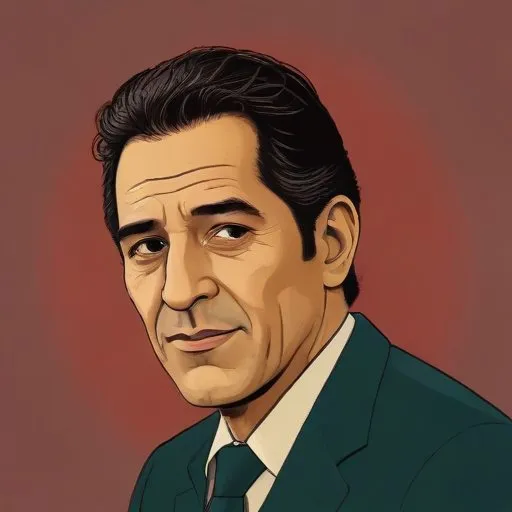
A renowned Brazilian writer and professor, celebrated for his innovative and provocative literary style, which explores themes of identity, politics, and social justice.
Joo Ubaldo Ribeiro was a renowned Brazilian writer, journalist, screenwriter, and professor, celebrated for his remarkable contributions to Brazilian literature. Several of his books and short stories have been adapted into movies and TV series in Brazil, solidifying his reputation as one of the country's most prolific and successful writers.
Ribeiro was born on January 23, 1941, in São Paulo, Brazil, to Manoel Ribeiro and Maria Felipa Osrio Pimental. When he was just two months old, his family moved to Aracaju, in the northeastern state of Sergipe. Ribeiro's early life was marked by a strong passion for literature, which would later become the driving force behind his successful career.
In 1955, Ribeiro began attending the Colgio da Bahia, where he befriended the famous Brazilian film director, Glauber Rocha. This friendship would prove to be instrumental in shaping Ribeiro's early writing career.
In 1957, Ribeiro started working as a journalist for local newspapers, an experience that would shape his writing style and provide valuable insight into the world of Brazilian literature. The following year, he enrolled in the Federal University of Bahia to study law, but his true calling remained writing.
In 1959, Ribeiro published his first anthology of stories from Bahia, titled Lugar e circunstncia (Place and Circumstance), which marked the beginning of his illustrious writing career. Over the years, he went on to write numerous novels, short stories, and screenplays, many of which were adapted into successful films and TV series in Brazil.
Ribeiro's breakthrough novel, Sargento Getlio, published in 1971, cemented his reputation as a masterful storyteller. This was followed by the equally acclaimed Vencecavalo e o outro povo in 1974. His contributions to Brazilian literature earned him a prestigious seat in the Brazilian Academy of Letters in 1994.
At the time of his passing in 2014, Ribeiro was widely regarded as one of Brazil's greatest contemporary novelists, leaving behind a legacy that continues to inspire and influence generations of writers and readers alike.
Ribeiro's personal life was marked by three marriages and five children. Despite the challenges he faced, including periods of exile and political turmoil, Ribeiro remained committed to his craft, leaving behind a body of work that continues to captivate and inspire audiences today.
Through his writing, Ribeiro not only reflected the complexities and nuances of Brazilian society but also contributed significantly to the country's cultural heritage. His legacy serves as a testament to the power of literature to transcend time and touch the human experience.
Born in 1912
A celebrated writer of novels and poetry that vividly capture the spirit of Brazil's people and culture, exploring themes of love, social justice, and identity. His works are considered some of the most important in Brazilian literature.
Born in 1920
A Ukrainian-Brazilian journalist and author who explored the human condition through lyrical, introspective fiction, often focusing on the inner lives of women. Her writing is celebrated for its poetic, philosophical, and psychological depth.
Born in 1902
A leading figure in Brazilian modernism, known for his introspective and lyrically rich poetry that explores themes of love, nature, and the human condition.
Born in 1913
A renowned poet, playwright, and composer who merged Brazilian rhythms with French existentialism, creating iconic bossa nova songs like "The Girl from Ipanema".
Born in 1902
A Portuguese journalist who covered several international conflicts, including the Portuguese Colonial War and the Carnation Revolution, providing firsthand reports from the front lines.
