


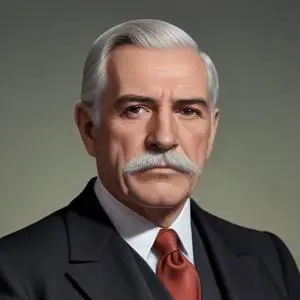
A prominent lawyer and politician who served as the 40th Speaker of the United States House of Representatives, known for his strong leadership and influential legislative reforms.
Joseph Gurney Cannon, a stalwart figure in American politics, served as the Speaker of the United States House of Representatives for eight years, earning him the reputation as one of the most powerful speakers in U.S. history. From 1903 to 1911, Cannon wielded significant influence over the legislative agenda, often finds himself at odds with the progressive policies of Presidents Theodore Roosevelt and William Howard Taft.
Born on May 7, 1836, in Guilford County, North Carolina, Cannon grew up in a Quaker family that abhorred slavery and eventually relocated to the Western frontier. After his father's untimely death in 1851, Cannon took charge of the family farm and worked as a clerk in a country store to support his family.
Cannon's fascination with the law led him to pursue a career in politics. He was admitted to the bar in 1858 and began practicing law in Illinois. His involvement in local politics led to his election to the Illinois State Legislature in 1861, marking the beginning of his illustrious career.
Cannon's political career spanned over five decades, during which he served 23 non-consecutive terms in the U.S. House of Representatives. He first took office in 1873 and continued to serve until his retirement in 1923, becoming the longest-serving member of Congress at the time.
As Speaker of the House, Cannon's tenure was marked by his staunch opposition to progressive reform efforts. He blocked key legislation, including the Federal Reserve Act and the 17th Amendment, which aimed to democratize the election of senators.
Cannon's leadership style was often criticized for being autocratic and dictatorial. His revocation of committee assignments and gag rules on debate sparked a revolt led by George W. Norris, which contributed to the Republican Party split in the 1910 and 1912 elections.
Despite his controversial tenure, Cannon's impact on American politics is undeniable. The Cannon House Office Building, named in his honor in 1962, stands as a testament to his enduring legacy.
Cannon's legacy extends beyond his tenure as Speaker of the House. His influence on American politics has shaped the course of history, and his commitment to women's suffrage and education reform continues to inspire generations of leaders.
As a testament to his enduring impact, the Cannon House Office Building remains a symbol of his dedication to public service and his unwavering commitment to the democratic process.
Born in 1858
A pioneering leader who championed progressive reforms, trust-busting, and conservation, earning a Nobel Peace Prize for mediating the Russo-Japanese War. He's also famous for his rugged outdoorsmanship and "big stick" diplomacy.
Born in 1857
The 27th President of the United States was a lawyer and jurist who served as the only person to hold the offices of President and Chief Justice of the United States. He's known for his significant contributions to the country's judicial system.
Born in 1865
The 29th President of the United States, a journalist-turned-politician, led the country through a period of post-war prosperity and scandalous corruption. He's infamous for his administration's numerous scandals and his own extramarital affairs.
Born in 1872
The 30th President of the United States, a lawyer and politician, led the country through a period of economic prosperity and limited government intervention, earning the nickname "Silent Cal" for his frugal and humble nature. He's most known for his minimalist approach to governance and tax cuts.
Born in 1874
The 31st President of the United States was a humanitarian and politician who led the country through the Great Depression and is known for his humanitarian efforts and infrastructure development. He's also infamous for his inability to mitigate the economic crisis.
Born in 1882
Led the United States through the Great Depression and World War II, implementing a series of reforms known as the New Deal and helping to establish the country as a global superpower.
Born in 1884
The 33rd President of the United States, a strong leader who made tough decisions, including dropping atomic bombs on Japan and establishing the Marshall Plan to rebuild Europe after WWII.
Born in 1890
Led the Allied forces to victory in World War II and later served as President, maintaining peace and prosperity during the Cold War era. He's known for his strategic leadership and diplomatic skills.
