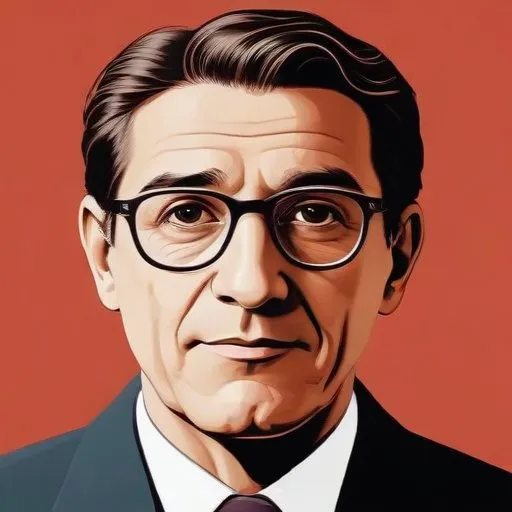
Joseph Kruskal: The Mathematician Who Unwound Complexity
Unraveling the Tangles of Multidimensional Scaling
Joseph Kruskal, a trailblazing American mathematician, statistician, computer scientist, and psychometrician, left an indelible mark on the world of mathematics and computer science. He is renowned for his groundbreaking work on multidimensional scaling, Kruskal's algorithm for computing the minimal spanning tree of a weighted graph, and his contributions to the field of psychometrics.
A Family of Intellectual Giants
Born on January 29, 1928, in New York City, Kruskal was part of a family that boasted exceptional intellectual talent. His brothers,
Martin David Kruskal and
William Kruskal, were accomplished mathematicians in their own right, with Martin co-inventing solitons and William developing the Kruskal-Wallis one-way analysis of variance. Joseph's nephew, Clyde Kruskal, is a prominent computer scientist and professor.
The Formative Years and Education
Kruskal's academic journey began at the University of Chicago, where he earned his Bachelor of Science in mathematics in 1948 and his Master of Science in mathematics in 1949. He then moved to Princeton University, completing his Ph.D. in 1954 under the guidance of Albert W. Tucker and Roger Lyndon, although his interactions with Paul Erdős had a significant impact on his work.
A Career of Many Facets
Kruskal's professional career spanned multiple disciplines, reflecting his diverse interests and expertise. He worked at Bell Labs from 1959 to 1993, contributing significantly to the fields of statistics, computer science, and psychometrics. He was a Fellow of the American Statistical Association, held presidencies in the Psychometric Society and the Classification Society of North America, and was an active champion of civil rights, serving as the first president of the Fair Housing Council of South Orange and Maplewood in 1963.
The Multidimensional Scaling Breakthrough
Kruskal's most seminal contribution to statistics is his work on multidimensional scaling, which allows for the visualization of complex data in lower-dimensional spaces. This innovation enabled researchers to unravel the intricacies of complex systems, making it an indispensable tool in various fields.
Kruskal's Algorithm: A Computer Science Landmark
In computer science, Kruskal's algorithm for computing the minimal spanning tree of a weighted graph has become a cornerstone of network analysis. This efficient and elegant approach has far-reaching applications in telecommunications, transportation networks, and other domains.
Legacy and Impact
Joseph Kruskal's work has left an enduring legacy, influencing generations of mathematicians, statisticians, and computer scientists. His contributions have shaped our understanding of complex systems, improved our ability to analyze and visualize data, and paved the way for breakthroughs in various fields.
- Awards and Honors: Kruskal was a recipient of the American Statistical Association's Samuel S. Wilks Award in 1987.
- Personal Milestones: He was an avid supporter of civil rights, actively participating in organizations such as CORE.
Kruskal's remarkable journey serves as a testament to the power of human ingenuity, curiosity, and passion. His work continues to inspire and influence researchers, ensuring that his legacy will remain an integral part of the mathematical and scientific landscape for generations to come.
FAQ
What is Joseph Kruskals most famous contribution to mathematics?
Joseph Kruskal is best known for his work on multidimensional scaling, which is a statistical technique used to analyze and visualize complex data sets.
What was Joseph Kruskals role in the development of computer science?
Joseph Kruskal was a pioneer in the development of computer science, making significant contributions to the fields of algorithms, data structures, and programming languages.
What awards did Joseph Kruskal win?
Joseph Kruskal was awarded the National Medal of Science in 1992 for his contributions to mathematics and computer science.
What was Joseph Kruskals educational background?
Joseph Kruskal earned his PhD in mathematics from Princeton University in 1954, and went on to hold faculty positions at several prominent universities, including Yale and Harvard.
What was Joseph Kruskals legacy in science?
Joseph Kruskals legacy in science is significant, as he helped lay the foundations for modern data analysis and visualization, and inspired generations of mathematicians and computer scientists.