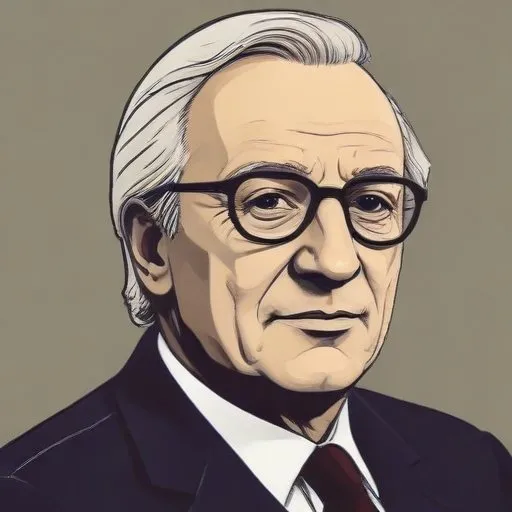
Joseph Luns: The Dutch Statesman who Shaped NATO's Destiny
A Life of Diplomacy and Statesmanship
Joseph Luns, a name synonymous with international diplomacy and strategic leadership, is best known for his remarkable tenure as the Secretary General of NATO from 1971 to 1984. As the longest-serving Secretary General in NATO's history, Luns played a pivotal role in shaping the alliance's trajectory during the Cold War era.
Early Life and Educational Pursuits
Born on August 28, 1911, in the Netherlands, Luns came from a family steeped in artistic and intellectual traditions. His father, Huib Luns, was a professor of architectural drawing at the Delft University of Technology, and his mother's family hailed from Alsace-Lorraine. Luns' early life was marked by a rich cultural heritage, which would later influence his approach to international relations.
Luns pursued higher education at the University of Amsterdam, where he studied law, and later at the Leiden University, where he earned a Master of Laws degree in 1937. His academic pursuits took him to the London School of Economics, where he obtained a Bachelor of Economics degree in 1938.
A Career in Politics and Diplomacy
Luns' entry into politics began in the 1940s, when he joined the Catholic People's Party (KVP), which later merged with the Christian Democratic Appeal (CDA). He served as a Member of the House of Representatives from 1946 to 1971, during which he held various portfolios, including Minister of Foreign Affairs.
Secretary General of NATO
In 1971, Luns was nominated as the Secretary General of NATO, a position he held for 13 years. During his tenure, he navigated the alliance through the complexities of the Cold War, skillfully balancing the interests of member states. Luns played a crucial role in maintaining NATO's unity and strengthening its relationships with European nations and the United States.
Philosophical Contributions and Beliefs
Luns was a firm believer in the importance of European integration and transatlantic cooperation. He advocated for a strong and united Europe, which he saw as essential for maintaining peace and stability in the face of Soviet aggression. His commitment to NATO's core values – collective defense, democracy, and individual liberty – earned him the respect of world leaders.
Legacy and Impact
Joseph Luns' legacy extends far beyond his remarkable tenure as NATO's Secretary General. He was a statesman who understood the intricacies of international politics and diplomacy. His leadership played a significant role in shaping NATO's response to the Cold War, and his vision for a united Europe continues to inspire generations of policymakers.
Personal Milestones and Key Life Events
- Born on August 28, 1911, in the Netherlands
- Conscripted in the Coastguard of the Royal Netherlands Navy (1930-1931)
- Earned a Bachelor of Laws degree from Leiden University (1933)
- Obtained a Bachelor of Economics degree from the London School of Economics (1938)
- Nominated as Secretary General of NATO (1971)
- Served as Secretary General of NATO (1971-1984)
- Retired from politics and became active in the public sector (1984)
- Passed away on July 17, 2002
Trivia and Fun Facts
- Luns was the longest-serving Secretary General in NATO's history.
- He was a skilled linguist, fluent in multiple languages, including Dutch, English, French, and German.
- Luns was an avid art lover and collector, with a particular fondness for French Impressionism.
FAQ
What was Joseph Luns role in NATO?
Joseph Luns served as the 5th Secretary General of NATO from 1971 to 1984, playing a crucial role in shaping the organizations policies during the Cold War era.
What were Joseph Luns key diplomatic achievements?
Joseph Luns negotiated several key diplomatic agreements, including the Helsinki Accords and the Ottawa Declaration, which helped to reduce tensions between the East and West during the Cold War.
What was Joseph Luns stance on European integration?
Joseph Luns was a strong supporter of European integration and worked to strengthen ties between European nations, particularly through his role as Dutch Foreign Minister from 1952 to 1971.
How did Joseph Luns respond to the Soviet Union during the Cold War?
Joseph Luns took a firm stance against Soviet aggression during the Cold War, advocating for a strong NATO presence and diplomacy to counterbalance Soviet power.
What was Joseph Luns legacy in the Netherlands?
Joseph Luns legacy in the Netherlands is marked by his commitment to diplomacy, European integration, and transatlantic relations, earning him the respect of his peers and the Dutch people.