


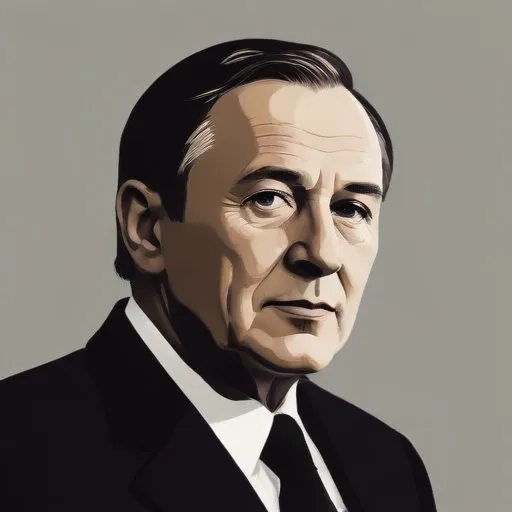
The 7th Secretary General of NATO, a German politician and diplomat who played a crucial role in shaping the alliance's policies during the Cold War era, particularly in the lead-up to the fall of the Berlin Wall. He's most known for his efforts to strengthen NATO's unity and cooperation with Eastern European countries.
Manfred Wrner, a German politician and diplomat, is best known for his remarkable tenure as the seventh Secretary General of NATO from 1988 to 1994, a pivotal period that saw the end of the Cold War and the reunification of Germany. During his time in office, Wrner played a crucial role in shaping the Alliance's strategic direction, earning him widespread recognition as a visionary leader.
Born on September 24, 1934, in Stuttgart-Bad Cannstatt, Wrner grew up in his grandfather's house and attended the Johannes-Kepler-Gymnasium. After graduating in 1953, he pursued law studies at Heidelberg, Paris, and Munich, completing his degree in 1957 and earning his doctorate in international law in 1961.
Wrner's political career began in the administration of Baden-Württemberg, where he worked as a county official for Oehringen and later for the Baden-Württemberg Landtag. In 1965, he joined the County Gppingen, further honing his skills as a politician. His dedication and expertise soon caught the attention of the German CDU, which led to his election to the German parliament in 1972, representing Gppingen.
On October 4, 1982, Wrner was appointed Federal Minister of Defence in Helmut Kohl's government, a position that allowed him to showcase his leadership acumen and strategic thinking. During his tenure, he played a key role in defending NATO's decision to deploy intermediate-range ballistic missiles, a move that significantly contributed to the eventual arms reduction talks with the Soviet Union.
Wrner's crowning achievement came when he assumed the role of NATO Secretary General in 1988. During his time in office, he navigated the Alliance through a turbulent period, marked by the end of the Cold War and the reunification of Germany. Despite being diagnosed with cancer, Wrner continued to serve with unwavering dedication, earning the respect and admiration of his peers and leaders around the world.
Wrner's leadership was instrumental in shaping NATO's post-Cold War strategy, which focused on building partnerships, promoting cooperative security, and enhancing crisis management capabilities. His vision for a more inclusive and cooperative security environment continues to influence NATO's policies and decisions today.
Wrner was married to Elfie Wrner, a devoted humanitarian who supported several German army-related charitable agencies. The couple had no children together. Despite his untimely passing on August 13, 1994, Wrner's legacy as a statesman, diplomat, and leader continues to inspire generations of policymakers and international relations experts.
Wrner's inspiring words continue to resonate with leaders and policymakers around the world:
Wrner's outstanding contributions to international relations and diplomacy were recognized with several awards and honors, including the Grand Cross of the Order of Merit of the Federal Republic of Germany.
Manfred Wrner's remarkable life and career serve as a testament to his unwavering commitment to public service, diplomacy, and international cooperation. His legacy continues to shape the global security landscape, inspiring future generations of leaders and policymakers to strive for a more peaceful and cooperative world.
96 Years Old
The first unified Germany's leader, who oversaw the country's reunification after the Berlin Wall's fall, and is credited with creating a strong, stable economy.
82 Years Old
The 7th Chancellor of Germany, a lawyer-turned-politician, led the country from 1998 to 2005, implementing significant economic and social reforms. He's known for his efforts to modernize Germany and strengthen the European Union.
93 Years Old
A French military officer and statesman who served as President of France from 1995 to 2007, known for his opposition to the US-led invasion of Iraq and his efforts to strengthen the European Union.
73 Years Old
The former Prime Minister of the United Kingdom who led the country through a transformative period, including the Iraq War, and is known for his charismatic leadership and controversial decisions.
80 Years Old
The 42nd President of the United States, a charismatic leader who reformed healthcare and economy, and infamous for his scandals.
87 Years Old
A Belgian maestro who led NATO as its 8th Secretary General, known for his diplomatic efforts to strengthen European security and defense. He also conducted several orchestras, blending music with politics.
84 Years Old
A Spanish physicist-turned-politician who served as Minister of Foreign Affairs, known for his diplomatic efforts in shaping the European Union's foreign policy. He played a key role in international crisis management and conflict resolution.
