


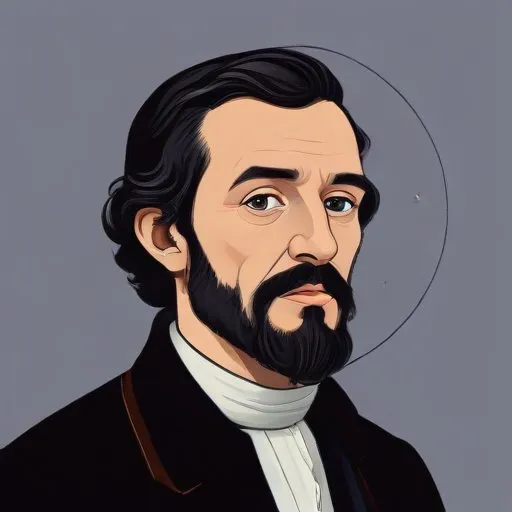
Developed the Delisle scale of temperature and created numerous astronomical and geographical maps, contributing significantly to the fields of astronomy and cartography.
Joseph-Nicolas Delisle, a 17th-century French astronomer, left an indelible mark on the scientific community with his groundbreaking inventions, cartographic skills, and astronomical discoveries. He is most famously known for developing the Delisle scale, a temperature scale that revolutionized the field of thermometry in 1732.
Born on April 4, 1688, in Paris, Delisle was one of 11 sons of Claude Delisle. Despite his family's classical roots, Joseph's curiosity led him to pursue a career in astronomy under the tutelage of renowned astronomers Joseph Lieutaud and Jacques Cassini.
Delisle's passion for astronomy earned him recognition from esteemed institutions. In 1712, he set up an observatory at the Luxembourg Palace, and later, at the Hotel de Taranne. From 1719 to 1722, he worked at the Royal Observatory, where he met Edmond Halley in London and discussed the transits of Venus.
In 1725, Delisle received an invitation from Peter the Great to establish and run a school of astronomy in Saint Petersburg. Although he arrived after the czar's death, Delisle's reputation as a brilliant astronomer earned him immense wealth and fame during his 22-year tenure in Russia.
Delisle's cartographic skills were instrumental in creating a map of the known North Pacific, which Vitus Bering later used during his expeditions.
Delisle's contributions to the scientific community earned him several prestigious honors:
In 1760, Delisle proposed an international scientific collaboration to observe the 1761 Transit of Venus, aiming to calculate the absolute distance of the Earth from the Sun. This groundbreaking initiative paved the way for modern astronomical research.
Joseph-Nicolas Delisle's remarkable life and achievements leave behind a rich legacy, inspiring future generations of astronomers, cartographers, and scientists to explore the wonders of the celestial realm.
Born in 1749
Developed nebular hypothesis of the origin of the solar system and formulated Laplace's equation, a fundamental concept in mathematics and physics. He's considered the founder of celestial mechanics.
Born in 1752
Developed the theory of elliptic integrals, and his work on number theory laid the foundation for modern cryptography.
Born in 1730
Cataloged many celestial objects, including nebulae and star clusters, creating a famous list still used by astronomers today.
Born in 1663
Developed innovative instruments, including the hygrometer and thermometer, and made significant contributions to the study of friction and temperature.
Born in 1717
A French Enlightenment thinker who made significant contributions to mathematics, physics, and philosophy, particularly in the fields of fluid dynamics and the study of vibrating strings. He's also known for his work on the Encyclopedia, a comprehensive reference work that aimed to compile all knowledge of the time.
