


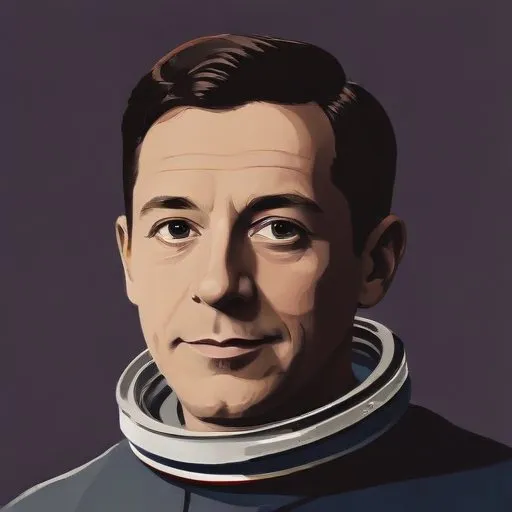
Physicist and astronaut who flew on the Space Shuttle Columbia in 1984, conducting experiments and testing equipment. He's known for his work on the development of the Space Shuttle program.
Joseph P. Allen, a renowned American astronaut, physicist, and administrator, is celebrated for his remarkable contributions to the National Aeronautics and Space Administration (NASA) and the field of space exploration. With a distinguished career spanning over three decades, Allen has left an indelible mark on the history of space travel and scientific research.
Born on June 27, 1937, in Crawfordsville, Indiana, Allen grew up in a family that valued education and encouraged his curiosity in science and mathematics. He attended Mills School and later graduated from Crawfordsville High School in 1955. Allen went on to earn a Bachelor of Arts degree in Mathematics and Physics from DePauw University in 1959, where he was a member of the prestigious Delta Chapter of Beta Theta Pi fraternity.
Allen's academic pursuits continued at Yale University, where he earned a Master of Science degree in 1961 and a Doctor of Philosophy in Physics in 1965. During his time at Yale, he worked alongside future physicist Richard F. Casten, laying the foundation for his future research endeavors.
In 1967, Allen was selected as a scientist-astronaut by NASA, becoming a member of the second group of scientist-astronauts. He completed flight training at Vance Air Force Base, Oklahoma, and served as mission scientist on the astronaut support crew for Apollo 15.
Allen's NASA experience was marked by several notable milestones, including his role as a staff consultant on science and technology to the President's Council on International Economic Policy. From 1975 to 1978, he served as NASA Assistant Administrator for Legislative Affairs in Washington, D.C., and later returned to the Johnson Space Center as a senior scientist astronaut.
One of Allen's most significant contributions was his work on the Operations Mission Development Group, where he played a crucial role in the development of the Space Shuttle program. He was a support crew member for the first orbital flight test of the Space Shuttle Columbia in April 1981 and served as the CAPCOM during the reentry phase of the mission.
Throughout his career, Allen has been driven by a passion for scientific inquiry and a commitment to advancing human knowledge. He has emphasized the importance of basic research and its potential to drive innovation and discovery.
Allen's work has been guided by a philosophical approach that values collaboration, curiosity, and creativity. He believes that the pursuit of knowledge should be a collective effort, and that scientists and policymakers must work together to address the complex challenges facing our world.
Joseph P. Allen's contributions to NASA and the field of space exploration have had a profound impact on modern society. His work on the Space Shuttle program has enabled numerous scientific discoveries and has paved the way for future generations of space travelers.
Allen's legacy extends beyond the realm of space exploration, inspiring countless individuals to pursue careers in science, technology, engineering, and mathematics (STEM). His commitment to education and public service has made a lasting impact on our understanding of the world and our place within it.
Despite his many achievements, Allen has remained humble and dedicated to his work. He has shied away from the spotlight, preferring to let his accomplishments speak for themselves.
Today, Joseph P. Allen is remembered as a pioneering figure in the history of space exploration, a testament to the power of human curiosity and determination.
Joseph P. Allen's legacy continues to inspire new generations of scientists, engineers, and astronauts. His contributions to NASA and the field of space exploration have paved the way for future discoveries and have left an indelible mark on the history of human spaceflight.
As we look to the future, we can draw inspiration from Allen's unwavering commitment to scientific inquiry, his passion for exploration, and his dedication to the pursuit of knowledge. His story serves as a powerful reminder of the importance of investing in education, research, and innovation, and of the boundless potential of the human spirit.
75 Years Old
American physicist and astronaut who broke barriers as the first woman in space, inspiring generations of women in STEM fields. Founded a company to promote science education and literacy.
97 Years Old
American baseball player who pitched in the Major Leagues from 1965 to 1975, known for being a four-time All-Star and winning the American League ERA title in 1968.
95 Years Old
First person to walk on the Moon during the Apollo 11 mission, marking a historic milestone in space exploration.
96 Years Old
Second man to walk on the Moon during the Apollo 11 mission, a pioneering astronaut and advocate for space exploration.
96 Years Old
Led the third manned mission to land on the Moon, Apollo 12, and became the third person to walk on its surface. Known for his bold and fearless approach to space exploration.
94 Years Old
One of the 12 humans to walk on the Moon during NASA's Apollo program, known for his moonwalk during Apollo 12 and later becoming a painter, capturing the beauty of space through art.
98 Years Old
Commander of the Apollo 13 mission, known for his heroic efforts in saving his crew after an explosion occurred on board. He's an iconic figure in space exploration history.
95 Years Old
Pilot, engineer, and astronaut who flew on four NASA spaceflights, including the Apollo-Soyuz Test Project, the first joint US-Soviet space mission. He was also a test pilot and held several records for altitude and speed.
