


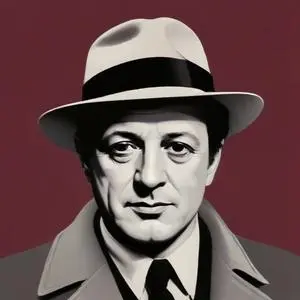
A pioneering filmmaker who directed iconic heist movies like "Rififi" and "Topkapi", known for his stylish and suspenseful storytelling.
Known for his gritty, stylish, and socially conscious films, Jules Dassin was a true original, a cinematic provocateur who refused to be bound by the constraints of the Hollywood system. With a career spanning over four decades, Dassin left an indelible mark on the film industry, earning critical acclaim and controversy in equal measure.
Born Julius Dassin on December 18, 1911, in Middletown, Connecticut, to Jewish immigrant parents from Odessa, Ukraine, Dassin grew up in Harlem, New York. His early life was marked by a passion for the performing arts, with stints in Yiddish theater and piano lessons.
Dassin's professional acting career began in 1926, at the tender age of 14, with the Yiddish Art Theatre in New York City. He eventually transitioned to directing, working on Broadway productions and earning critical acclaim for his innovative approaches to staging and storytelling.
In the late 1940s, Dassin's career was derailed by the Red Scare and the Hollywood blacklist. Accused of being a Communist sympathizer, Dassin was forced to flee to Europe, where he continued to work in film, producing some of his most iconic works.
In France, Dassin directed the groundbreaking Du rififi chez les hommes (1955), a tense, stylish heist film that earned him the Best Director Award at the Cannes Film Festival. This success was followed by the critically acclaimed Never on Sunday (1960), which earned Dassin an Academy Award nomination for Best Director.
Dassin's films often explored themes of social justice, personal freedom, and the human condition. His work reflected his own progressive politics and his commitment to telling stories that challenged the status quo.
As a director, Dassin was known for his meticulous attention to detail, his innovative use of camera angles, and his ability to coax powerful performances from his actors. He was a true auteur, a master of his craft who left an indelible mark on the film industry.
Dassin's influence can be seen in the work of filmmakers such as Jean-Pierre Melville, Martin Scorsese, and Brian De Palma, who have all cited him as an inspiration. His films continue to be celebrated for their bold, uncompromising vision, and their ability to capture the essence of the human experience.
In 2002, the Cinémathèque Française honored Dassin with a retrospective of his work, solidifying his position as a cinematic legend. Today, his films remain a testament to his innovative spirit, his unwavering commitment to his art, and his enduring legacy as a master filmmaker.
"I never made a film to make money. I made films because I had to make them."
"I'm not interested in making films that are just entertainment. I want to make films that are about something."
"The most important thing in filmmaking is to be true to yourself, to be honest, and to take risks."
Jules Dassin's life and career serve as a testament to the power of creative vision and the importance of staying true to one's artistic ideals. As a filmmaker, he was a true original, a master of his craft who left an indelible mark on the film industry.
Born in 1920
A Greek triple threat who dazzled audiences with her fiery spirit and captivating performances, while also championing cultural preservation and education as a government minister.
Born in 1909
A pioneering filmmaker who explored themes of social class and identity in his critically acclaimed movies, often blending genres and pushing boundaries.
95 Years Old
A pioneer of French New Wave cinema, known for experimental and provocative films that challenged traditional narrative structures and explored themes of politics, philosophy, and social commentary.
94 Years Old
A pioneering filmmaker of the French New Wave, known for directing iconic films like "Jules and Jim" and "The 400 Blows", which redefined cinematic storytelling.
83 Years Old
Acclaimed filmmaker behind gritty, intense, and visually stunning movies that often explore themes of redemption, faith, and the human condition, with a distinctive directing style that blends violence and artistry.
83 Years Old
Academy Award-winning actor, entrepreneur, director, and producer, renowned for iconic roles in films like "Taxi Driver" and "Raging Bull", and his versatility in both dramatic and comedic performances.
Born in 1924
A cultural icon who revolutionized acting with his intense, nuanced performances, earning him numerous accolades, including two Oscars. He's synonymous with iconic roles in "A Streetcar Named Desire" and "The Godfather".
