


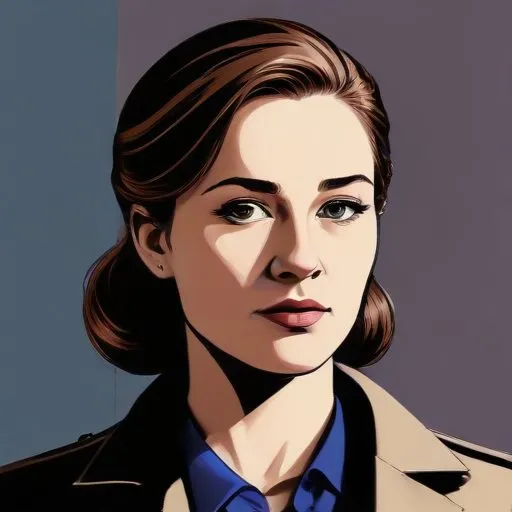
A British spy who worked for MI5, known for being a double agent, feeding false information to the Germans during World War II, while secretly working for the British government.
Julia Pirie, a British spy, worked for MI5 from the 1950s to the 1990s, earning her place in history as one of the most unlikely yet effective undercover agents of her time. Pirie's remarkable career was marked by her daring infiltration of the Communist Party of Great Britain, where she worked her way up the ranks, gathering crucial information and passing it on to her MI5 handlers.
Born on July 8, 1918, in Harbury, Pirie's life took a dramatic turn when her father, Allen Grant Pirie, died in 1923 from wounds sustained in World War I. She moved to Calcutta with her mother, Elizabeth Marie Pirie, before returning to England in 1939 to join the Auxiliary Territorial Service (ATS) as a driver.
Pirie's work with the ATS and her later employment with the Duchess of Atholl, a fierce opponent of Soviet control in Europe, laid the groundwork for her eventual recruitment by MI5. Her membership in the First Aid Nursing Yeomanry (FANY), a organization known to have been a recruiting ground for the Special Operations Executive and MI5, further solidified her position as a prime candidate for espionage work.
Pirie's ability to blend in and her unassuming demeanor made her the perfect candidate to infiltrate the Communist Party. Working as a typist, she gradually built trust within the party, eventually rising through the ranks to work directly under party secretary John Gollan. This position granted her access to sensitive information, which she would then pass on to her MI5 handlers.
Her work within the party was remarkable, with some speculating that she may have been the inside agent who provided crucial information for two important MI5 operations described in Peter Wright's book Spycatcher. Pirie's efforts contributed significantly to the weakening of the Communist Party, which was further exacerbated by the Soviet invasions of Hungary in 1956 and Czechoslovakia in 1968.
Julia Pirie's remarkable career as an undercover agent left an indelible mark on the world of espionage. Her bravery, intelligence, and cunning allowed her to navigate the complex and treacherous world of Cold War politics, making her a true pioneer in the field of espionage.
Despite her remarkable achievements, Pirie remained humble and unassuming, never drawing attention to herself. Her legacy serves as a testament to the power of quiet determination and the impact that one person can have on the course of history.
Little is known about Pirie's personal life, with her MI5 work remaining classified until her death on September 2, 2008. Her later years were marked by her withdrawal from the Communist Party in 1978, as the organization's power began to wane.
Julia Pirie's remarkable story serves as a reminder of the often-overlooked contributions of women in the world of espionage. Her bravery, intelligence, and cunning have earned her a place among the pantheon of espionage legends, inspiring generations to come.
Born in 1912
A high-ranking member of British intelligence who defected to the Soviet Union, revealing secrets and compromising national security. Known for being a notorious double agent during the Cold War.
Born in 1911
A high-ranking member of the British intelligence community who defected to the Soviet Union, notorious for betraying his country and compromising national security.
Born in 1907
A renowned art historian who led a secret life as a Soviet spy, betraying his country by passing classified information to the KGB. His espionage activities were only discovered in 1979, sparking a national scandal.
94 Years Old
A former British intelligence officer turned bestselling author, crafting gripping spy novels that explore the complexities of espionage and human nature. His works have been adapted into films and TV series, captivating audiences worldwide.
