


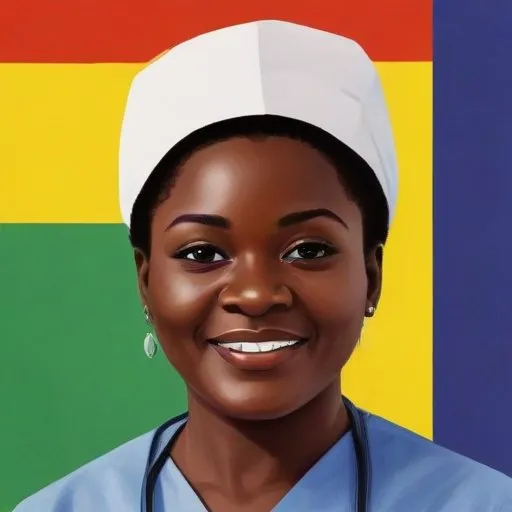
A pioneering nurse and politician who played a key role in Ghana's independence movement and was the first woman to hold a ministerial position in the country. She advocated for women's rights and education.
Juliana AzumahMensah is a renowned Ghanaian politician and nurse, known for her groundbreaking contributions to the fields of healthcare and politics. As the former Minister for Women and Children's Affairs and Member of Parliament for Ho East constituency, she has left an indelible mark on the country's social and political landscape.
Born on June 15, 1950, in Koforidua, Eastern Region of Ghana, Juliana AzumahMensah's journey began in the picturesque town of Agortime-Kpetoe, where she received her primary and middle school education at the Roman Catholic Primary and Local Authority Middle Schools. She later attended OLA Girls Senior High School in Ho, Volta Region, where she obtained her GCE Ordinary Level in 1969.
Her pursuit of higher education took her to the United Kingdom, where she trained at the Ipswich East Anglia School of Nursing in Ipswich, Suffolk, qualifying as a State Registered Nurse in August 1973. A year later, she specialized in Midwifery at Saint Peters Hospital in Chertsey, Surrey, graduating as a State Certified Midwife in August 1975.
AzumahMensah's illustrious career spanned multiple continents and fields. She began as a clerical officer at the Ministry of Finance and Economic Planning in 1969, before pursuing further studies in the UK. Her nursing career took her to various hospitals in the UK, Saudi Arabia, and Ghana.
Between 1978 and 1984, she worked at the King Abdulaziz University Hospital in Saudi Arabia, followed by stints at the Mayday University Hospital in the UK and the Ho Diocese in Ghana. Her vast experience in healthcare led to her appointment as the Executive Secretary/Director of Health Services of the Ho Diocese and the Regional Coordinating Director between 2001 and 2005.
AzumahMensah's foray into politics began with her election as Member of Parliament for the Ho East Constituency in 2005, a position she held until 2013. During her tenure, she chaired the Parliamentary Select Committee on Health and was a member of the Appointments Committee.
Her most notable achievement was her appointment as the Minister for Women and Children's Affairs in 2009, a role that enabled her to champion women's empowerment and children's welfare. Her dedication to these causes earned her recognition as one of Ghana's most influential women in politics.
AzumahMensah's remarkable contributions to healthcare and politics have been acknowledged with various awards and honors. She received the Order of the Volta, one of Ghana's highest national honors, in 2007.
In recognition of her commitment to women's empowerment, she was awarded the Africa Regional Award for Excellence in Women's Leadership by the African Leadership Forum in 2012.
Juliana AzumahMensah's remarkable journey serves as a testament to the power of dedication, hard work, and passion. Her contributions to healthcare and politics have inspired a generation of Ghanaian women to pursue careers in these fields.
As a trailblazer in Ghanaian politics, AzumahMensah's legacy extends beyond her achievements, symbolizing hope and empowerment for women and children across the continent.
Beyond her professional accomplishments, AzumahMensah's life is marked by a deep sense of purpose and compassion. Her commitment to her family and community has been a driving force throughout her career.
As a devoted mother and public servant, Juliana AzumahMensah's inspiring story serves as a beacon of hope, encouraging future generations to strive for excellence and make a meaningful impact in their communities.
Born in 1909
First President of Ghana, leading the country to independence from British colonial rule and promoting Pan-Africanism. He's known for his vision of a united Africa and his role in shaping modern Ghana.
67 Years Old
A Ghanaian historian and politician who served as the 4th President of Ghana, known for his efforts to improve the country's infrastructure and economy. He also wrote several books on Ghanaian history and politics.
