


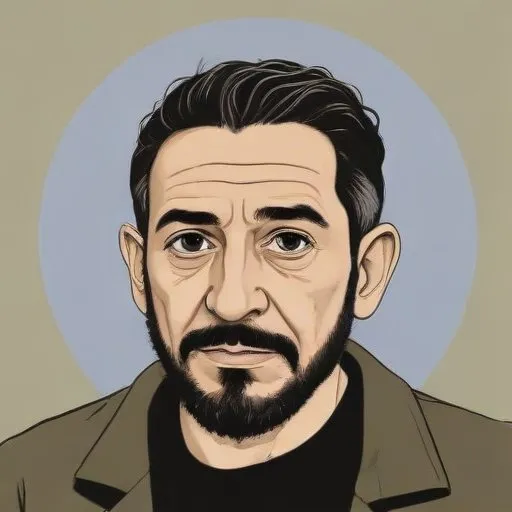
An Israeli actor, director, and activist who founded the Freedom Theatre in Jenin, promoting peaceful resistance and empowering Palestinian youth through art, and was tragically assassinated in 2011.
Juliano MerKhamis, an Israeli-Palestinian actor, director, filmmaker, and political activist, is best known for establishing The Freedom Theatre in Jenin, a city in the West Bank. Through his work, MerKhamis aimed to bring about social change and promote peaceful coexistence between Israelis and Palestinians.
MerKhamis was born on May 29, 1958, in Nazareth, Israel, to Arna Mer-Khamis, a former Palmach combatant turned communist, and Saliba Khamis, an Eastern Orthodox Palestinian Christian and leader of the Israeli Communist Party. His parents' mixed background and conflicted identities would later influence MerKhamis's own outlook on life.
MerKhamis's father abandoned the family when he was just 10 years old, and he was later forced to attend school in Haifa. This tumultuous childhood would shape his future as an activist. He went on to serve in the Israeli Defense Forces as a combat soldier in the Paratroopers Brigade, despite not being drafted, due to his eagerness to fight for his country.
In 2006, MerKhamis co-founded The Freedom Theatre, a community-based theatre and cultural centre in Jenin. The theatre aimed to provide a safe space for young Palestinians to express themselves, build confidence, and challenge the occupation. MerKhamis believed that through art and theatre, individuals could overcome their differences and work towards peace.
Tragically, MerKhamis's life was cut short on April 4, 2011, when he was assassinated by a masked gunman outside The Freedom Theatre. His death sent shockwaves throughout the international community, with many mourning the loss of a visionary and champion of peace.
MerKhamis's legacy continues to inspire generations. The Freedom Theatre remains a symbol of resistance and hope, with his widow, Jenny Nyman, continuing his work. His courage and dedication to promoting peaceful coexistence have inspired countless individuals to work towards a more harmonious future.
"Theatre is a way to resist, to challenge, to question, and to express."
MerKhamis believed that art and theatre could be a powerful tool for social change, bringing people together to overcome their differences and work towards a more harmonious future.
MerKhamis's work and philosophy can be compared to that of other notable activists and artists who have used their platforms to promote social change, such as Chilean poet and playwright Ariel Dorfman and South African playwright Athol Fugard.
MerKhamis's work has had a lasting impact on modern society, inspiring a new generation of activists and artists to use their platforms to promote peaceful coexistence and social change.
MerKhamis was posthumously awarded the Prince Claus Award in 2011 for his outstanding contribution to the freedom of expression and cultural development in the Arab region.
76 Years Old
A renowned filmmaker and writer, known for exploring the complexities of Israeli society and politics through his thought-provoking documentaries and feature films. His works often spark intense debates and discussions.
