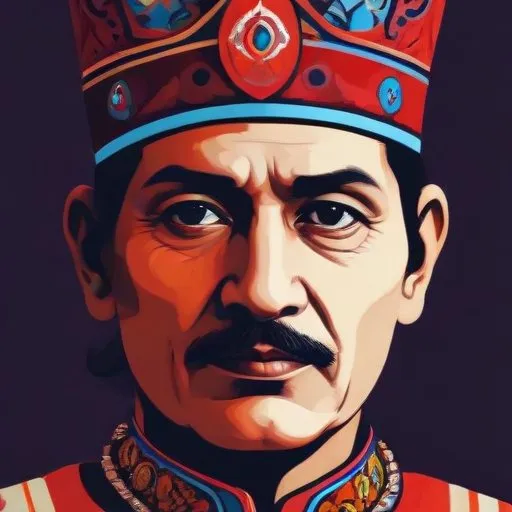
Jung Bahadur Rana: The Architect of Modern Nepal
A Legacy of Reform and Controversy
Jung Bahadur Rana, born Bir Narsingh Kunwar in 1817, is known for his tumultuous rise to power and his role in shaping modern Nepal. He is credited with eliminating factional fighting at the royal court, introducing innovations in the bureaucracy and judiciary, and making concerted efforts to modernize Nepal.
Early Life and Family
Jung Bahadur Rana was born in Balkot, southern Nepal, to Bal Narsingh Kunwar, a bodyguard of King Rana Bahadur Shah, and his second wife, Ganesh Kumari. Through his mother, he was connected to the Thapa dynasty of Mukhtiyar Bhimsen Thapa, a prominent ruling family in Nepal.
Rise to Power
In 1846, Jung Bahadur Rana was accused of plotting with the junior queen to overthrow the king and place her son on the throne. Despite this controversy, he managed to rise through the ranks and eventually became the Prime Minister of Nepal in 1846. He ruled Nepal for 31 years, implementing numerous reforms and centralizing power.
Reforms and Legacy
During his tenure, Jung Bahadur Rana introduced several reforms, including:
- Establishing a modern bureaucracy and judiciary system
- Implementing a new system of land revenue and taxation
- Promoting trade and commerce, leading to economic growth
- Introducing modern education and healthcare systems
However, his rule was also marked by controversy, including accusations of tyranny, debauchery, and economic exploitation. Some historians blame him for setting up a dark period of Nepalese history, an oppressive dictatorship that lasted 104 years.
Philosophical Contributions and Beliefs
Jung Bahadur Rana was known for his pragmatic approach to governance, blending traditional Nepalese values with modern Western ideas. He believed in the importance of education and modernization, and his reforms reflected this philosophy.
Influence on Modern Society
Jung Bahadur Rana's legacy continues to shape modern Nepal. His reforms laid the foundation for Nepal's modern institutions and bureaucracy. However, his controversial rule has also left a lasting impact on Nepal's social and political landscape.
Historical Context and Legacy
Jung Bahadur Rana's rule occurred during a time of great change and upheaval in Nepal. His reforms and modernization efforts were instrumental in shaping Nepal's transition from a feudal state to a modern nation. Despite controversy surrounding his rule, he remains one of the most important figures in Nepalese history.
Comparative Analysis with Contemporaries
Jung Bahadur Rana's rule can be compared to that of other Asian leaders of the time, such as
Queen Victoria of the United Kingdom and the Meiji Emperor of Japan. While all three leaders implemented reforms and modernization efforts, Jung Bahadur Rana's rule was marked by controversy and accusations of tyranny.
Quotes and Memorable Sayings
"I am not a king, I am a servant of the people." - Jung Bahadur Rana
This quote reflects Jung Bahadur Rana's philosophy of governance, emphasizing his commitment to serving the people of Nepal.
Conclusion
Jung Bahadur Rana was a complex and multifaceted figure, whose rule had a lasting impact on Nepal. While controversy surrounds his legacy, his reforms and modernization efforts laid the foundation for modern Nepal. His story serves as a testament to the power of leadership and the complexity of human history.
FAQ
What was Jung Bahadur Ranas role in Nepalese history?
Jung Bahadur Rana was a Nepalese ruler who played a crucial role in unifying Nepal and establishing its modern borders. He was a skilled diplomat and military leader who expanded Nepals territory and established its independence.
How did Jung Bahadur Rana modernize Nepal?
Jung Bahadur Rana introduced several modernizing reforms in Nepal, including the establishment of a modern army, a centralized administration, and a formal education system. He also promoted trade and commerce with neighboring countries.
What were Jung Bahadur Ranas military achievements?
Jung Bahadur Rana was a skilled military commander who won several battles, including the Nepalese-Tibetan War and the Anglo-Nepalese War. He was known for his bravery and tactical genius.
What was Jung Bahadur Ranas role in Nepalese politics?
Jung Bahadur Rana was a dominant figure in Nepalese politics, serving as Prime Minister and Maharajah of Nepal. He established a hereditary system of government and ruled Nepal for over 30 years.
What is Jung Bahadur Ranas legacy in Nepalese history?
Jung Bahadur Rana is remembered as one of the greatest leaders in Nepalese history. His achievements and reforms continue to shape Nepals culture, economy, and politics to this day.