


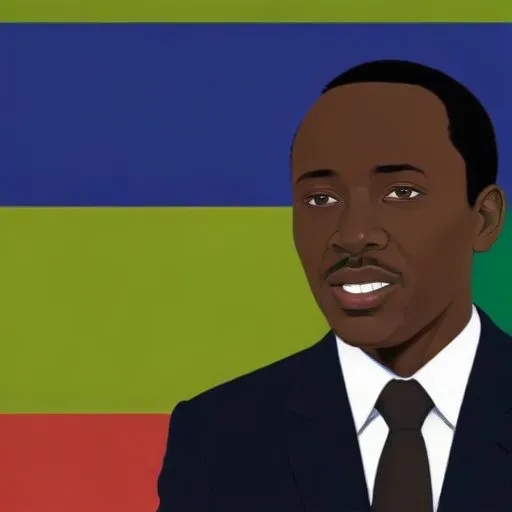
The President of Rwanda from 1973 to 1994, known for his authoritarian rule and role in the events leading up to the Rwandan genocide. He sparked ethnic tensions and violence that ultimately led to the deaths of hundreds of thousands of people.
Juvnal Habyarimana, the second president of Rwanda, remains a figure of immense controversy and intrigue, known for his authoritarian rule, alleged electoral fraud, and suspected role in the Rwandan genocide.
Born on March 8, 1937, in Gisenyi, Ruanda-Urundi, Habyarimana hailed from a wealthy Hutu family. He received his primary education before attending the College of Saint Paul in Bukavu, Belgian Congo, where he graduated with a degree in mathematics and humanities.
Habyarimana's entry into politics was marked by his military background, serving in several security positions, including minister of defense under Rwanda's first president, Grégoire Kayibanda. In 1973, he overthrew Kayibanda in a coup, assuming the presidency and continuing his predecessor's pro-Hutu policies.
During his rule, Rwanda became a totalitarian, one-party state, where Habyarimana's MRND party enforced a cult of personality, with citizens required to chant and dance in adulation of the President at mass pageants of political animation. Electoral fraud was suspected in his unopposed reelections, with him securing 98.99%, 99.97%, and 99.98% of the vote in 1978, 1983, and 1988, respectively.
In 1990, the Tutsi-led Rwandan Patriotic Front (RPF) launched a civil war against Habyarimana's government. After three years of conflict, he signed the Arusha Accords in 1993 with the RPF as a peace agreement.
Habyarimana's life was cut short on April 6, 1994, when his plane, carrying the President of Burundi, Cyprien Ntaryamira, was shot down by a missile near Kigali. His assassination sparked ethnic tensions and contributed to the Rwandan genocide, which claimed the lives of over 800,000 people, primarily Tutsi and moderate Hutu.
Habyarimana's leadership was marked by a strong sense of Hutu nationalism and a belief in the superiority of the Hutu people. His policies and ideology contributed to the polarization of Rwandan society, ultimately culminating in the genocide.
Juvnal Habyarimana's presidency remains a dark chapter in Rwandan history, marked by authoritarianism, ethnic strife, and devastating violence. His legacy serves as a cautionary tale about the dangers of unchecked power, nationalism, and ethnic divisions.
Habyarimana's rule was marked by numerous controversies, including allegations of human rights abuses, electoral fraud, and corruption. His assassination has also been shrouded in mystery, with various theories emerging about the perpetrators and their motives.
Juvnal Habyarimana's presidency has had a profound impact on modern Rwandan society, with the country still grappling with the legacy of his rule and the devastating consequences of the genocide.
Habyarimana's authoritarian rule and nationalist ideology can be compared to other African leaders of the time, such as Uganda's Idi Amin and Zaire's Mobutu Sese Seko. However, the scale and brutality of the Rwandan genocide set him apart from his contemporaries.
68 Years Old
The leader who oversaw Rwanda's transformation from devastating genocide to economic growth and stability, known for his authoritarian rule and human rights controversies.
