


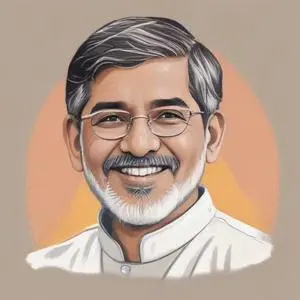
An Indian engineer and activist who dedicated his life to combating child labor and promoting children's education, ultimately earning a Nobel Peace Prize for his tireless efforts. He is a champion of children's rights and a beacon of hope for a more just and equitable world.
Kailash Satyarthi, a Indian social reformer, is renowned for his unwavering dedication to eradicating child labor and championing the universal right to education. In 2014, he was awarded the Nobel Peace Prize, along with Malala Yousafzai, for his tireless efforts in promoting children's rights and education.
Born as Kailash Sharma on January 11, 1954, in Vidisha, India, Satyarthi was deeply distressed by the prevalent social injustices in his community. This sparked a sense of purpose within him, driving him to become a champion for the rights of the marginalized and oppressed.
In 1980, Satyarthi founded Bachpan Bachao Andolan (Save the Childhood Movement), a pioneering organization dedicated to rescuing children from forced labor, slavery, and trafficking. Through this initiative, Satyarthi and his team have liberated over 86,000 children in India from the shackles of exploitation.
In 1998, Satyarthi conceptualized and led the Global March Against Child Labor, a historic 80,000 km march across 103 countries. This unprecedented movement brought together children, youth, and supporters worldwide to demand an end to child labor and advocate for education as a fundamental right. The march's success paved the way for the adoption of the ILO Convention 182 on the Worst Forms of Child Labour in 1999.
Satyarthi's remarkable work has earned him numerous accolades, including:
Satyarthi firmly believes that every child deserves the right to education, and that education is the key to unlocking human potential. He advocates for a world where children are valued and protected, and where their voices are heard and respected.
In 2017, Satyarthi led the Bharat Yatra, a 19,000 km march across India, to demand legislation against child rape and prostitution. This courageous effort brought attention to the plight of India's most vulnerable children and pressured the government to take concrete action.
Kailash Satyarthi's unwavering commitment to the cause has inspired a generation of social activists and reformers. His work has not only improved the lives of countless children but has also shaped global policies and laws protecting children's rights. As a beacon of hope, Satyarthi continues to inspire and empower people to join the fight against child labor and advocate for education as a fundamental human right.
"Every child matters, and every child deserves an education."
"The power of a single individual can bring about change, and collective action can bring about revolution."
Kailash Satyarthi's remarkable journey serves as a testament to the power of courage, compassion, and determination. His unwavering dedication to the cause of education and child rights continues to inspire and empower people worldwide, ensuring a brighter future for generations to come.
29 Years Old
A courageous advocate for girls' education, particularly in her native Swat Valley, who survived a Taliban assassination attempt and continues to inspire global change through her activism and writing.
56 Years Old
Indian National Congress leader and scion of the Nehru-Gandhi family, known for his efforts to revitalize the party and promote social justice.
75 Years Old
The Chief Minister of Gujarat and 14th Prime Minister of India, a prominent figure in Indian politics, known for his economic reforms and nationalist agenda. He has been a dominant force in Indian politics for over two decades.
53 Years Old
Regarded as one of the greatest batsmen in cricket history, he is known for his incredible technical skills and record-breaking career spanning over two decades.
83 Years Old
A legendary Indian film icon, known for his charismatic on-screen presence and versatility in over 190 films, earning him the title "Shahenshah of Bollywood".
92 Years Old
A renowned economist and philosopher who has made significant contributions to welfare economics, social choice theory, and development economics, and is known for his work on poverty, famine, and human development.
