


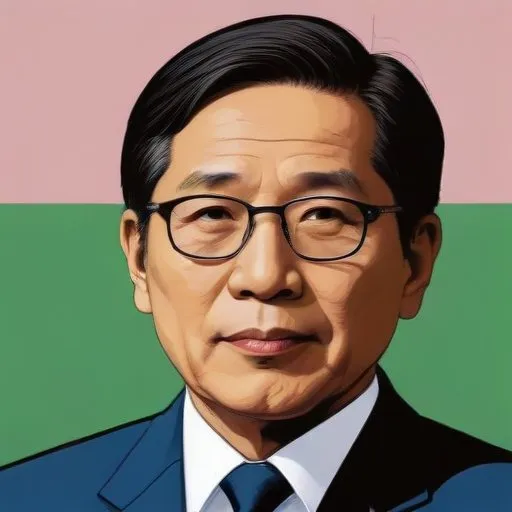
A Taiwanese politician who served as the Minister of the Interior and was a key figure in Taiwan's democratization process, known for his efforts to promote human rights and social justice.
Kang Ninghsiang is a renowned Taiwanese politician, known for his unwavering dedication to the Tangwai movement and his pioneering role in shaping Taiwan's democratic landscape. With a political career spanning over four decades, Kang has left an indelible mark on the country's history, paving the way for future generations of leaders.
Born on November 16, 1938, in Wanhua, Taiwan, Kang was raised in a family that instilled in him the values of public service and social responsibility. He pursued his higher education at National Chung Hsing University, where he earned a degree in public administration.
Kang's entry into politics began during Taiwan's martial law era, a tumultuous period marked by strict government control and limited freedom of expression. Undeterred by the risks, Kang threw his hat into the ring, supporting Huang Hsinchieh's 1969 legislative election campaign. This marked the beginning of his own political journey, which would take him from the Taipei City Council to the Legislative Yuan, and eventually, to the National Assembly.
Kang's early foray into politics was marked by his advocacy for social welfare and his commitment to increasing the representation of native Taiwanese in the government. His stance earned him the ire of the Kuomintang, which issued him formal warnings for being too critical of the government. However, this did not deter Kang, who went on to win his first national-level election in 1972, securing approximately 83,000 votes.
In 1986, Kang became one of the founding members of the Democratic Progressive Party (DPP), a move that cemented his position as a champion of Taiwanese democracy. Although his party membership was suspended during his tenure on the Control Yuan, Kang remained a stalwart supporter of the DPP's ideals.
In 1975, Kang launched the magazine Taiwan Political Forum, also known as the Taiwan Political Review, which became a platform for discussing Taiwan's political landscape. However, the government banned the publication after just five issues, citing its critical stance towards the government.
In the latter stages of his career, Kang served as an administrative deputy minister of national defense, secretary-general of the National Security Council, and adviser to President Chen Shui-bian. Throughout his life, Kang has remained committed to promoting Taiwan's democratic values, earning him the respect and admiration of his peers and constituents alike.
Today, Kang Ninghsiang's legacy continues to inspire generations of Taiwanese politicians, serving as a testament to his unwavering commitment to democracy and public service.
76 Years Old
The 12th President of the Republic of China, a Hong Kong-Taiwanese commander and politician, is known for his efforts to improve relations with mainland China and his role in shaping Taiwan's economy. He's also recognized for his moderate stance on Taiwanese independence.
69 Years Old
The first female president of Taiwan, known for her efforts to strengthen the country's sovereignty and promote its international presence, while navigating complex relations with China.
