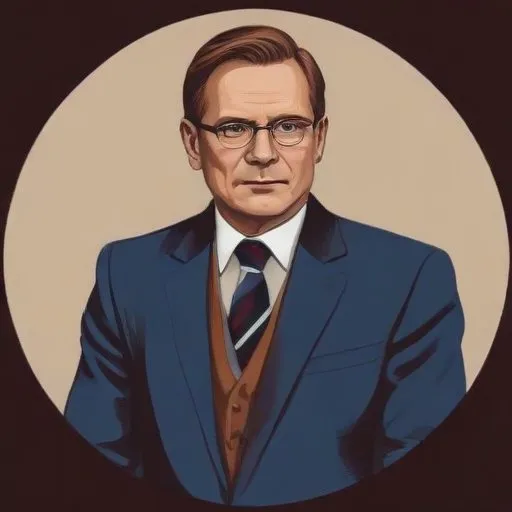
Karl-August Fagerholm: The Leading Politician of Finland's Social Democrats
Known for his remarkable three-term tenure as Prime Minister of Finland, Karl-August Fagerholm was a prominent Finnish politician who left an indelible mark on the country's political landscape. As the leader of the Social Democratic Party, Fagerholm played a crucial role in shaping Finland's post-war era, earning him recognition as one of the most influential politicians of his time.
A Humble Beginning
Born on December 31, 1901, in Siuntio, Finland, Fagerholm's early life was marked by tragedy when his father, Johan August Fagerholm, a stonecutter, passed away six months before his birth. His mother, Olga Serafina Worbs (née Nordman), raised him along with his siblings. Fagerholm's early years saw him working as a paperboy for Hufvudstadsbladet and later as a barber. He even briefly chaired the Barbers' Union from 1920 to 1923.
Rise to Prominence
Fagerholm's entry into politics began in 1930 when he was elected to the Finnish Parliament. During the 1920s and 1930s, the Social Democratic Party faced significant challenges in the aftermath of the Finnish Civil War, where they had been on the defeated side. Fagerholm worked tirelessly to revive the party's fortunes, eventually becoming the Minister for Social Affairs in 1937, a position he held until 1943.
Prime Minister of Finland
Fagerholm's three terms as Prime Minister (1948-1950, 1956-1957, and 1958-1959) were marked by his commitment to the Scandinavia-oriented neutralist policy, which aimed to maintain Finland's independence in the face of mounting pressure from the Soviet Union. As a Swedish-speaking Finn, Fagerholm was seen as more palatable to the Soviet leadership than his predecessor, Vin Tanner.
A Legacy of Leadership
Throughout his career, Fagerholm navigated the complex web of Finnish politics, often finding himself at odds with both the Soviet Union and the Communist Party of Finland. Despite narrowly losing the presidential election to
Urho Kekkonen in 1956, Fagerholm remained a respected figure in Finnish politics, leaving behind a legacy of dedication, perseverance, and statesmanship.
Personal Milestones
- 1930: Elected to the Finnish Parliament
- 1937: Became Minister for Social Affairs
- 1943: Stepped down as Minister for Social Affairs
- 1948-1950: First term as Prime Minister of Finland
- 1956-1957: Second term as Prime Minister of Finland
- 1958-1959: Third term as Prime Minister of Finland
- 1956: Lost presidential election to Urho Kekkonen
- May 22, 1984: Passed away in Helsinki, Finland
Fagerholm's remarkable life and career serve as a testament to his unwavering commitment to his country and its people. As a champion of Finnish independence and a stalwart leader, Karl-August Fagerholm's legacy continues to inspire generations of Finnish politicians and citizens alike.
FAQ
What was Karl-August Fagerholms role in Finnish politics?
Karl-August Fagerholm was a prominent figure in Finnish politics, serving as the Prime Minister of Finland from 1948 to 1950 and again from 1956 to 1957. He was also the Speaker of the Parliament of Finland from 1945 to 1947 and from 1950 to 1956.
What was Karl-August Fagerholms party affiliation?
Karl-August Fagerholm was a member of the Social Democratic Party of Finland, which he represented in the Parliament of Finland from 1930 to 1966.
What were Karl-August Fagerholms achievements as Prime Minister?
During his tenure as Prime Minister, Karl-August Fagerholm focused on post-war reconstruction and economic development in Finland. He also played a key role in negotiating Finlands relationships with the Soviet Union and the Western Bloc.
What was Karl-August Fagerholms relationship with Urho Kekkonen?
Karl-August Fagerholm had a close relationship with Urho Kekkonen, who served as the President of Finland from 1956 to 1982. Fagerholm supported Kekkonens presidential campaign and worked closely with him on matters of foreign policy and economic development.
What is Karl-August Fagerholms legacy?
Karl-August Fagerholms legacy lies in his contributions to Finnish politics and his role in shaping the countrys post-war development. He is remembered as a skilled politician and diplomat who worked to promote Finlands interests on the international stage.