


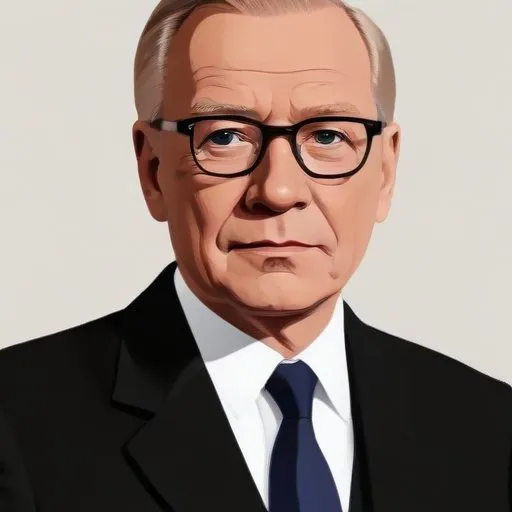
A Finnish leader who served as President from 1956 to 1982, known for maintaining Finland's neutrality during the Cold War and fostering good relations with the Soviet Union.
Urho Kekkonen, affectionately known as UKK, is renowned for his remarkable 26-year tenure as the President of Finland, making him the longest-serving president in Finnish history. During his presidency, Kekkonen masterminded Finland's precarious balancing act between the Western world and the Soviet Union, earning him both praise and criticism.
Born on September 3, 1900, in Pielavesi, Finland, Kekkonen grew up in a rural family and studied law at the University of Helsinki. He embarked on his political journey in the 1930s, joining the Agrarian League (later known as the Centre Party), and was first elected to the Finnish Parliament in 1936.
Kekkonen's pragmatic approach to politics and his ability to navigate Finland's complex relationships with its neighbors propelled him to the presidency in 1956. He went on to win four consecutive presidential elections, solidifying his grip on Finnish politics.
Kekkonen built upon the foundations laid by his predecessor, Juho Kusti Paasikivi, and developed the Paasikivi-Kekkonen doctrine. This policy of active neutrality allowed Finland to maintain its independence while cultivating strong relationships with both NATO and the Warsaw Pact. Although critics dubbed this approach "Finlandization," it enabled Finland to thrive economically while avoiding entanglement in the Cold War.
Kekkonen's leadership style was often criticized for being authoritarian, and his tendency to divide and rule in domestic politics weakened Finnish democracy. Additionally, his dominance of the political landscape led to accusations of suppressing opposition.
Despite controversies, Kekkonen's foreign and trade policies enabled Finland's market economy to flourish, paving the way for the country's eventual integration into the European Union. His presidency also saw the hosting of the Conference on Security and Cooperation in Europe in Helsinki in 1975, earning him consideration for the Nobel Peace Prize.
Today, Kekkonen's legacy serves as a poignant reminder of the delicate balance between national sovereignty and international relations. His contributions to Finnish politics and diplomacy continue to shape the country's identity and its place in the global arena.
Urho Kekkonen married Sylvi Salome Uino in 1926, and the couple had two daughters together. Throughout his life, Kekkonen was an avid outdoorsman and nature lover, often finding solace in hiking and fishing.
Urho Kekkonen passed away on August 31, 1986, leaving behind a complex yet enduring legacy that continues to influence Finnish politics and society.
Born in 1861
Finnish literary pioneer and social commentator, known for his influential novels and essays that explored the country's cultural identity and social issues.
Born in 1861
Finnish lawyer, judge, and politician who served as the 3rd President of Finland, known for his role in the country's independence from Russia. He played a key part in shaping Finland's early years as a sovereign state.
Born in 1889
A Finnish lawyer and politician who served as the Governor of the Bank of Finland and the 5th President of Finland, known for leading the country through World War II. He played a crucial role in maintaining Finland's independence and sovereignty during the war.
Born in 1867
A Finnish military leader and statesman who served as the 6th President of Finland, known for leading the country through World War II and maintaining its independence. He's also revered for his role in shaping modern Finland's identity and politics.
89 Years Old
A Finnish statesman and Nobel laureate who served as President of Finland and mediated several international conflicts, earning him the Nobel Peace Prize in 2008.
82 Years Old
Finnish lawyer and politician who served as the 11th President of Finland, known for being the first female head of state in the country. She's a champion of human rights and social justice.
78 Years Old
The 12th President of Finland, a decorated war hero and seasoned politician, led the country through economic turmoil and strengthened its international presence. He's known for his calm and collected leadership style.
Born in 1923
Finnish banker and politician who served as the 9th President of Finland, known for his leadership during a period of significant economic and political change. He played a key role in Finland's integration into the European Union.
