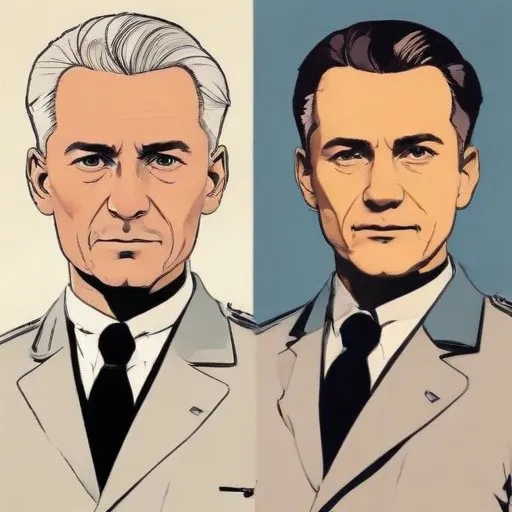
Karl Brandt

Karl Brandt

Karl Brandt was born on January 8th, 1904

Full Name: Karl Brandt
Born: January 8, 1904
Died: June 2, 1948
Nationality: German
Occupation: Physician, SS officer
Notable Post: Personal physician to Adolf Hitler
Education: University of Hamburg
Career Span: 1932-1945

A high-ranking Nazi officer and physician who oversaw the Nazi euthanasia program, responsible for the deaths of thousands of people with mental and physical disabilities.

Written by: Lisa Chang Lisa Chang

Karl Brandt: The Controversial Physician and Nazi Officer

Karl Brandt was a German physician and Schutzstaffel (SS) officer who became notorious for his involvement in human experimentation and the Aktion T4 euthanasia program under the Nazi regime. As Adolf Hitler's escort doctor, Brandt held a significant position in the inner circle of the Führer, which led to his eventual indictment and execution for war crimes.

Early Life and Education

Brandt was born on January 8, 1904, in Mulhouse, Alsace-Lorraine, Germany (now in Haut-Rhin, France). He came from a family of a Prussian Army officer and went on to become a medical doctor and surgeon in 1928, specializing in head and spinal injuries.

Rise to Prominence in Nazi Germany

Brandt joined the Nazi Party in January 1932 and met Hitler in the summer of the same year. He became a member of the SA in 1933 and the SS on July 29, 1934, with the officer rank of Untersturmführer. From the summer of 1934, he served as Hitler's escort physician, a position that granted him access to the Führer's inner circle.

Personal Life

Brandt married Anni Rehborn, a champion swimmer, on March 17, 1934. The couple had one child, Karl Adolf Brandt, born on October 4, 1935. Brandt was of the Protestant faith.

Career in Nazi Germany

Brandt was one of the medical scientists involved in performing abortions on women deemed genetically disordered, mentally or physically disabled, or racially deficient, as part of the 1933 Nazi law, Gesetz zur Verhütung erbkranken Nachwuchses (Law for the Prevention of Hereditarily Diseased Offspring). These abortions were legalized, and Brandt's involvement in this program marked the beginning of his controversial career.

The Aktion T4 Euthanasia Program

Brandt was selected by Philipp Bouhler, the head of Hitler's Chancellery, to administer the Aktion T4 euthanasia program. This program aimed to kill mentally and physically disabled individuals, which was deemed a means to "purify" the Aryan race. Brandt's involvement in this program led to the deaths of thousands of innocent people.

War Crimes and Trial

After the war, Brandt was indicted in late 1946 and faced trial before a U.S. military tribunal along with 22 others in the United States of America v. Karl Brandt, et al. case. He was convicted of war crimes, including human experimentation and other atrocities committed during the Aktion T4 program.

Execution and Legacy

On June 2, 1948, Karl Brandt was sentenced to death and hanged. His involvement in the Nazi regime's atrocities and his role in the Aktion T4 program have left an indelible mark on history, serving as a reminder of the dangers of unchecked power and the importance of upholding human rights and dignity.

Karl Brandt's story serves as a somber reminder of the devastating consequences of unchecked power and the importance of promoting human rights and dignity. His involvement in the Aktion T4 program will forever be etched in history as a dark chapter in human experimentation and medical ethics.

Timeline
1904
Born in Mühlhausen
Karl Brandt was born on January 8, 1904, in Mühlhausen, German Empire.
1928
Received Medical Degree
Brandt received his medical degree from the University of Berlin, where he later became a professor.
1934
Joined Nazi Party
Brandt joined the Nazi Party and became involved in the regimes eugenics and euthanasia programs.
1947
Convicted of War Crimes
Brandt was convicted of war crimes at the Nuremberg Trials and sentenced to death.
1948
Executed in Landsberg
Karl Brandt was executed on June 2, 1948, in Landsberg Prison, Bavaria, Germany.
Karl Brandt

Karl Brandt Quiz

Karl Brandt's role in the Nazi regime was that of a

Score: 0/5
FAQ
What was Karl Brandts role in the Nazi regime?
Karl Brandt was a high-ranking official in the Nazi regime, serving as Adolf Hitlers personal physician and one of the leaders of the Nazi euthanasia program. He was responsible for overseeing the forced sterilization and murder of people with disabilities, as well as the implementation of other Nazi medical policies.
What was Karl Brandts involvement in the Nazi euthanasia program?
Karl Brandt was one of the main architects of the Nazi euthanasia program, which aimed to eliminate people with mental and physical disabilities. He played a key role in the development and implementation of the program, including the establishment of a network of killing centers and the recruitment of medical professionals to carry out the killings.
How did Karl Brandts medical background influence his role in the Nazi regime?
Karl Brandts medical background and training as a physician gave him a level of credibility and expertise that was exploited by the Nazi regime. His medical knowledge and experience were used to justify and implement the Nazi euthanasia program, and his involvement helped to lend a veneer of scientific legitimacy to the regimes atrocities.
What was Karl Brandts fate after World War II?
After World War II, Karl Brandt was arrested and tried for his role in the Nazi regime. He was convicted of war crimes and crimes against humanity and was executed by hanging in 1948.
What is Karl Brandts legacy in the history of medicine?
Karl Brandts legacy in the history of medicine is one of infamy and shame. His involvement in the Nazi euthanasia program and his role in perpetuating the regimes atrocities serve as a dark reminder of the dangers of medical professionals becoming complicit in human rights abuses. His actions have also led to important discussions about medical ethics and the importance of upholding human rights and dignity.