


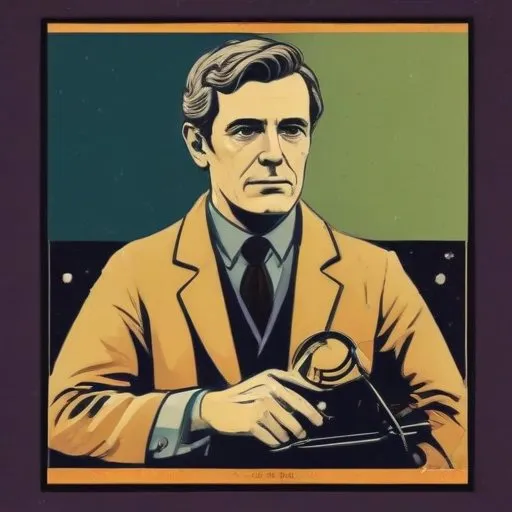
An Irish astronomer who calculated the luminosity of stars and proposed the existence of red dwarf stars, making significant contributions to stellar astrophysics.
Kenneth Edgeworth, an Irish army officer, engineer, economist, and independent theoretical astronomer, is best known for proposing the existence of a disc of bodies beyond the orbit of Neptune in the 1930s, a concept that would later be confirmed as the Edgeworth-Kuiper belt.
Edgeworth was born on February 26, 1880, at Daramona House, Street, County Westmeath, Ireland, to Elizabeth Dupré (née Wilson) and Thomas Newcomen Edgeworth, a land agent of Anglo-Irish ancestry. His family moved to the estate at Kilshruley, County Longford, where his uncle, William Wilson, had built an observatory and workshop, sparking Edgeworth's fascination with astronomy.
In the 1930s, Edgeworth proposed the existence of a disc of bodies beyond Neptune's orbit, a concept that was well ahead of its time. He believed that the solar system was not limited to the nine planets known at the time and hypothesized that a vast number of small, icy bodies existed in a region beyond Neptune.
Decades later, in 1992, Edgeworth's theory was confirmed with the discovery of the Kuiper belt, a region of our solar system that contains many small, icy bodies, including Pluto, Eris, and Makemake. Today, the Kuiper belt is recognized as a fundamental component of our solar system, and Edgeworth's pioneering work is acknowledged as a crucial contribution to our understanding of its structure.
Edgeworth's work was recognized with his election as a Fellow of the Royal Astronomical Society (RAS) in 1938.
Edgeworth wrote an autobiography, which he dedicated to his uncle, William Wilson, and the scientific friends who had inspired him. He passed away on October 10, 1972, leaving behind a legacy that continues to inspire astronomers and scientists today.
Edgeworth's work embodied a profound curiosity about the universe and its mysteries. His proposal of the Kuiper belt was a testament to his boundless imagination and his willingness to challenge conventional wisdom. His legacy serves as a reminder of the power of human ingenuity and the importance of pursuing unconventional ideas.
The discovery of the Kuiper belt has had far-reaching implications for our understanding of the solar system and its formation. It has also opened up new avenues for research, from the study of comets and asteroids to the search for extraterrestrial life.
Born in 1738
A pioneering astronomer and musician who discovered Uranus and two of its moons, and also composed symphonies and concertos.
Born in 1750
First female astronomer to receive a salary, discovered several comets and double stars, and assisted her brother William in his astronomical observations.
Born in 1792
Developed a system of mathematical astronomy, cataloging over 2,500 nebulae and star clusters, and made significant contributions to the field of photography. His work laid the foundation for modern astronomy and astrophysics.
Born in 1923
A renowned astronomer and TV personality who presented the BBC's "The Sky at Night" for over 50 years, sharing his passion for space and astronomy with the masses.
Born in 1882
A pioneer in astrophysics, he formulated the Eddington limit, a crucial concept in understanding stars, and was a key figure in popularizing Einstein's theory of relativity. His work bridged the gap between theory and observation in astronomy.
Born in 1915
A renowned astronomer and science fiction author who proposed the steady state theory of the universe and coined the term "Big Bang", making significant contributions to our understanding of the cosmos.
84 Years Old
A brilliant mind who unraveled the mysteries of black holes and the universe, making complex physics accessible to all through bestselling books.
Born in 1656
Predicted celestial events, including the return of a comet that bears his name, and made significant contributions to navigation, astronomy, and mathematics.
