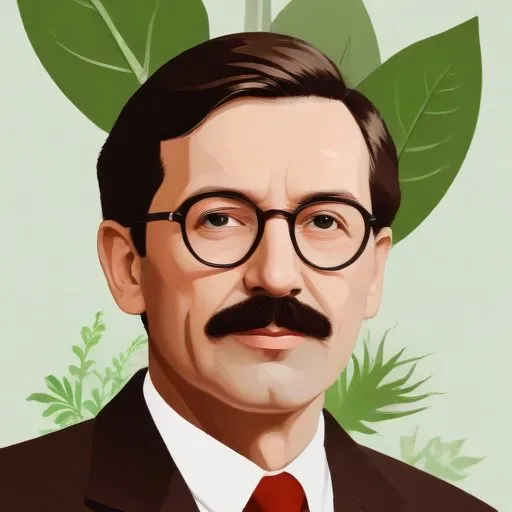
Kenneth V. Thimann

Kenneth V. Thimann

Kenneth V. Thimann was born on August 5th, 1904

Full Name: Kenneth Vivian Thimann
Place of Birth: Ashford, England
Profession: Botanist and Microbiologist
Nationality: English-American
Born: August 5, 1904
Died: January 15, 1997
Notable Work: Plant hormone research
Awards: National Medal of Science

A pioneer in plant hormone research, discovering and isolating auxins, which regulate plant growth and development. His work laid the foundation for modern plant biology and agriculture.

Written by: David Williams David Williams

Kenneth V. Thimann: The Pioneer of Plant Hormones

Kenneth Vivian Thimann, a renowned English-American plant physiologist and microbiologist, is best known for his groundbreaking research on plant hormones, which revolutionized the fields of agriculture and horticulture. His pioneering work led to the discovery of auxin, the first known plant hormone, and his identification of indole-3-acetic acid as an auxin remains a significant milestone in plant physiology.

Early Life and Education

Born on August 5, 1904, in Ashford, England, Thimann developed an early interest in chemistry and biochemistry, pursuing his Bachelor's and Ph.D. degrees at Imperial College, University of London. He also obtained a diploma from the University of Graz, showcasing his commitment to academic excellence.

Career Highlights and Major Works

Thimann's academic career spanned several prestigious institutions, including the University of London, California Institute of Technology, and Harvard University, where he spent most of his early career (1935-1965). During this period, he co-authored the influential book Phytohormones with F.W. Went in 1937, which laid the foundation for modern plant hormone research. In 1946, Thimann became the director of Harvard's Biological Laboratories, a position he held until 1950. He was elected to the American Academy of Arts and Sciences in 1938 and the United States National Academy of Sciences in 1948, solidifying his reputation as a leading scientist. In 1955, Thimann wrote The Life of Bacteria, a seminal book on microbiology that further cemented his authority in the field. He was elected to the American Philosophical Society in 1959 and later became the Higgins Professor of Biology at Harvard.

Legacy at the University of California, Santa Cruz

In 1965, Thimann moved to the University of California, Santa Cruz (UCSC), where he played a pivotal role in shaping the institution's science departments as the first provost of Crown College. His tireless efforts led to the establishment of the UCSC Arboretum and its extensive botanical collection. After retiring as provost in 1972, Thimann continued to contribute to UCSC until 1989, leaving a lasting legacy in the world of plant physiology and microbiology.

Awards and Honors

Thimann's outstanding contributions to science were recognized through various awards and honors, including his election to the American Academy of Arts and Sciences, the United States National Academy of Sciences, and the American Philosophical Society.

Influence on Modern Society

Thimann's work on plant hormones has had a profound impact on modern agriculture and horticulture, enabling the development of more efficient farming practices and improving crop yields. His research has also influenced the understanding of plant growth and development, benefiting fields such as forestry, ecology, and environmental science.

Personal Milestones and Key Life Events

Thimann's life was marked by several personal milestones, including his move to the United States in 1930 and his later relocation to Haverford, Pennsylvania, in 1989. Throughout his life, he remained dedicated to advancing scientific knowledge, inspiring future generations of researchers and scholars.

Philosophical Contributions and Beliefs

Thimann's work embodies the spirit of scientific inquiry and discovery, underscoring the importance of fundamental research in improving our understanding of the natural world. His commitment to advancing knowledge and promoting academic excellence continues to inspire scientists and scholars worldwide.

Final Years and Legacy

Kenneth V. Thimann passed away on January 15, 1997, leaving behind a rich legacy in the fields of plant physiology and microbiology. His contributions continue to influence modern scientific research, ensuring that his work remains a testament to the power of human curiosity and scientific inquiry.
Timeline
1904
Birth in England
Kenneth V. Thimann was born on August 5, 1904, in Ashford, Kent, England.
1925
Studied Botany
Thimann began studying botany at Imperial College in London, where he developed an interest in plant physiology.
1930
Research Fellowship
Thimann was awarded a research fellowship at Cambridge University, where he worked on plant hormones and growth regulation.
1946
Moved to Harvard
Thimann moved to Harvard University, where he became a professor of biology and continued his research on plant physiology.
1997
Death in Massachusetts
Kenneth V. Thimann died on January 15, 1997, at the age of 92, in Cambridge, Massachusetts, leaving behind a legacy as a renowned botanist and plant physiologist.
Kenneth V. Thimann

Kenneth V. Thimann Quiz

What is the primary area of research that Kenneth V. Thimann is known for?

Score: 0/5
FAQ
What was Kenneth V. Thimanns contribution to botany?
Kenneth V. Thimann was an English-American botanist who made significant contributions to the field of plant physiology. He discovered the plant hormone ethylene and explored its role in plant growth and development.
What was Kenneth V. Thimanns research on plant hormones?
Kenneth V. Thimanns research on plant hormones focused on the role of ethylene in plant growth and development. He demonstrated that ethylene regulates fruit ripening, senescence, and abscission.
How did Kenneth V. Thimanns work impact agriculture?
Kenneth V. Thimanns work on plant hormones has had a significant impact on agriculture. His research on ethylene has led to the development of new methods for ripening fruit and improving crop yields.
What was Kenneth V. Thimanns role in the development of plant physiology?
Kenneth V. Thimann was a prominent plant physiologist who helped to establish the field of plant physiology as a major area of research. He was a pioneer in the study of plant hormones and their role in plant growth and development.
What is Kenneth V. Thimanns legacy in botany?
Kenneth V. Thimanns legacy in botany is one of groundbreaking research and discovery. He helped to shape our understanding of plant growth and development, and his work continues to inspire new generations of botanists and plant physiologists.

Related People:

Barbara McClintock

Born in 1902

Pioneering geneticist who discovered transposons, mobile genetic elements that jump from one location to another in a genome, revolutionizing our understanding of genetic variation and evolution.

James Watson

98 Years Old

Discovered the structure of DNA, revolutionizing our understanding of genetics and earning a Nobel Prize. Pioneering work in molecular biology has far-reaching implications for medicine and beyond.

Francis Crick

Born in 1916

Pioneering scientist who discovered the structure of DNA, revolutionizing our understanding of genetics and life itself.

Rosalind Franklin

Born in 1920

A British scientist who contributed significantly to the discovery of the structure of DNA, providing high-quality X-ray crystallography images that helped James Watson and Francis Crick develop their famous model.

Maurice Wilkins

Born in 1916

A Nobel Prize-winning physicist and biologist who contributed significantly to the discovery of the structure of DNA, using X-ray crystallography to produce the first clear images of the molecule.

Linus Pauling

Born in 1901

Pioneering chemist and peace activist who won two unshared Nobel Prizes, one for chemistry and one for peace, for his groundbreaking work on the nature of the chemical bond and his tireless efforts to promote nuclear disarmament.

Erwin Chargaff

Born in 1905

A pioneer in DNA research, this biochemist discovered the base pairing rules of DNA, leading to a fundamental understanding of genetic code.

Theodosius Dobzhansky

Born in 1900

A pioneer in evolutionary biology, he integrated genetics and evolution, revolutionizing our understanding of species adaptation and diversity. His work laid the foundation for modern evolutionary theory.