


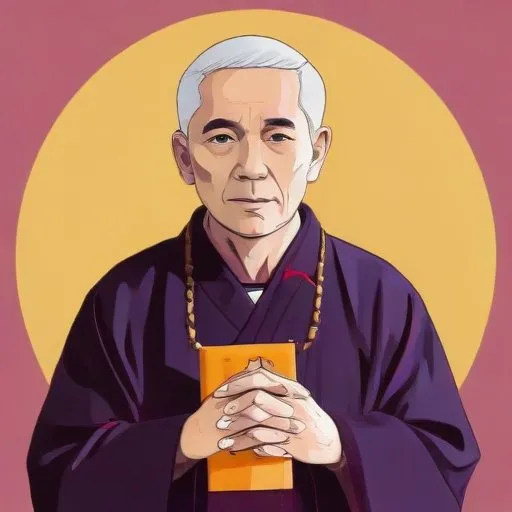
A humble Japanese priest and poet who captured the beauty of everyday life in haiku, often focusing on the struggles of the common people. His poetry is celebrated for its simplicity, depth, and insight into human nature.
Kobayashi Issa, born June 15, 1763, is revered as one of the four haiku masters in Japan, alongside Bashō, Buson, and Shiki. His profound contribution to the world of haiku poetry has earned him the respect and admiration of literary enthusiasts worldwide.
Issa was born as Kobayashi Nobuyuki, the first son of a farmer family in Kashiwabara, now part of Shinanomachi, Shinano Province (present-day Nagano Prefecture). Tragedy struck early, as his mother passed away when he was just three years old. This devastating loss was the beginning of a series of challenges that Issa would face throughout his life.
Despite his grandmother's loving care, Issa's life was marred by feelings of loneliness and estrangement. His father's remarriage five years later brought new dynamics to the family, and Issa's half-brother was born two years later. The loss of his grandmother at the age of 14 left Issa feeling abandoned and disillusioned with his family life.
In an effort to provide for himself, Issa was sent to Edo (present-day Tokyo) by his father, where he began to explore the world of haiku poetry. Little is known about the next ten years of his life, but his association with Kobayashi Chikua of the Nirokuan haiku school is well-documented. Though the nature of their relationship remains unclear, it is evident that Issa's early experiences laid the foundation for his future success.
Issa's haiku poems, characterized by their simplicity, depth, and emotional authenticity, continue to captivate readers to this day. His unique style, which often incorporated elements of humor and irony, set him apart from his contemporaries and earned him widespread recognition.
Issa's haiku poems often reflected his beliefs as a lay Buddhist priest of the Jōdo Shinshū sect. His poetry was infused with a sense of compassion, empathy, and awareness, reflecting his commitment to the principles of Buddhism.
Through his haiku, Issa conveys the importance of living in the present moment, embracing the beauty of nature, and cultivating a sense of detachment from worldly desires. His poetry is a testament to the transformative power of mindfulness and the pursuit of spiritual understanding.
Issa's haiku poems have transcended cultural boundaries, inspiring generations of writers, poets, and artists worldwide. His work continues to influence modern Japanese literature and has played a significant role in shaping the country's literary identity.
Today, Issa's poetry serves as a beacon of hope, reminding us of the importance of compassion, empathy, and mindfulness in an increasingly complex and chaotic world.
"Even a cockroach can be a good teacher."
"A frog's song is not spoilt by his ugliness."
These simple yet profound statements reflect Issa's humility, openness to experience, and willingness to find beauty in the most unexpected places.
Issa's haiku poetry has inspired numerous adaptations, including films, novels, and even music. His work continues to captivate artists and creatives, who find solace in his unique perspective and wisdom.
As a testament to his enduring legacy, Issa's poetry remains a powerful tool for self-reflection, personal growth, and spiritual exploration, offering a timeless message of hope and redemption to readers around the world.
Issa's contributions to Japanese literature have been recognized and celebrated through various awards and honors, solidifying his position as one of the greatest haiku masters of all time.
Kobayashi Issa's life was a testament to the power of perseverance, creativity, and spiritual exploration. Through his haiku poetry, he has left an indelible mark on the world, inspiring countless individuals to explore the depths of human experience and the beauty of nature.
In the end, Issa's legacy reminds us that even in the darkest of times, there is always hope, always beauty to be found, and always a chance to rediscover ourselves through the simplicity and profundity of haiku poetry.
Born in 1867
A leading figure in Japanese literature, known for revitalizing haiku poetry and creating a new style that focused on everyday life and nature. His work had a significant impact on modern Japanese literature.
Born in 1885
A renowned poet and author of the Meiji period, known for his romantic and melancholic works that explored themes of love, nature, and the human condition.
