


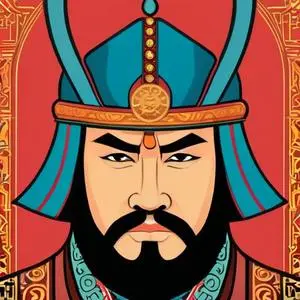
Founded the Yuan dynasty in China, extending the Mongol Empire's reach and establishing trade routes, cultural exchange, and administrative systems that shaped the region's development.
Kublai Khan, the founder and first emperor of the Mongol-led Yuan dynasty of China, left an indelible mark on the course of history with his visionary leadership, military conquests, and cultural achievements. As the grandson of Genghis Khan, Kublai Khan's name is synonymous with the Mongol Empire's expansion into Eastern Asia, and his reign is remembered for its significant cultural, economic, and political transformations.
Born on September 23, 1215, Kublai Khan was the second son of Tolui and Sorghaghtani Beki, a wise and influential mother who played a crucial role in shaping his early life. Growing up, Kublai Khan was exposed to the teachings of Buddhism, which would later influence his policies and worldview. Following the death of his brother Mngke in 1260, Kublai Khan succeeded him as the Khagan of the Mongol Empire, but his younger brother Ariq Bke challenged his authority, sparking the Toluid Civil War (1260-1264).
In 1271, Kublai Khan proclaimed the dynastic name "Great Yuan" and established the Yuan dynasty, marking the beginning of a new era in Chinese history. He claimed orthodox succession from prior Chinese dynasties, and by 1279, the Yuan conquest of the Song dynasty was complete, making Kublai Khan the first non-Han emperor to rule all of China proper.
Kublai Khan's reign was characterized by a cultural renaissance, as he patronized arts, literature, and architecture. The construction of the majestic capital city of Dadu (modern-day Beijing) and the development of the Grand Canal, a significant transportation route, are testaments to his vision and leadership. The Mongol Empire's emphasis on trade and cultural exchange facilitated the spread of ideas, goods, and technologies between East Asia, the Middle East, and Europe.
Kublai Khan's military campaigns expanded the Yuan Empire's borders, incorporating present-day Mongolia, Korea, southern Siberia, and adjacent regions into the empire. His influence extended to the Ilkhanate and the Golden Horde, and he even sent diplomatic missions to the courts of Europe.
Kublai Khan was known for his tolerance and openness to different cultures and religions. He was a patron of Tibetan Buddhism and invited the Tibetan monk Drogon Chogyal Phagpa to become his spiritual advisor. The emperor's philosophical leaning towards Buddhism is reflected in his policies, which promoted peace, harmony, and coexistence among the diverse peoples of his empire.
Kublai Khan's legacy continues to shape modern society, with the Yuan dynasty's cultural, economic, and political achievements influencing the development of China and beyond. His vision of a unified and harmonious empire, achieved through military conquest and cultural exchange, remains an inspiration to leaders and policymakers around the world.
Kublai Khan's remarkable life and achievements serve as a testament to his vision, leadership, and cultural achievements, cementing his place as one of the most remarkable figures in history.
Born in 1209
The Mongolian emperor who expanded the Mongol Empire, conquering vast territories and establishing a vast network of trade routes, while also promoting religious tolerance and meritocracy.
