


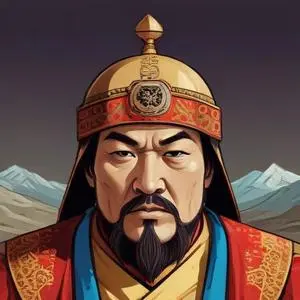
The second Great Khan of the Mongol Empire, who expanded the empire's territories through military campaigns and established trade routes, is most known for his military conquests and administrative skills. He played a crucial role in shaping the Mongol Empire's governance and economy.
Gedei Khan, also known as Ogodei Khan, is renowned for his remarkable leadership and military prowess, which enabled the Mongol Empire to reach unprecedented heights during his reign from 1229 to 1241. As the third son of the legendary Genghis Khan, Gedei Khan continued the expansion of the empire, conquering vast territories and solidifying the Mongols' position as a dominant world power.
Gedei Khan's early life was marked by his military prowess, as he fought alongside his father in numerous battles, honing his skills and proving his mettle in combat. His father's trust in him was evident when Gedei was granted a large appanage and entrusted with several wives, including the influential Toregene. His role in the Mongol invasion of the Khwarazmian Empire further solidified his position as a respected military leader.
As Khan, Gedei Khan pursued an aggressive expansionist policy, launching a second invasion of Persia in 1230, led by Chormaqan Noyan. This campaign resulted in the subjugation of the Khwarazmian prince Jalal al-Din and the beginning of Georgian subjugation. He also initiated the Mongol invasions of Korea and skirmished with the Song dynasty in China.
Aside from his military conquests, Gedei Khan is also credited with developing the Mongol state's administrative infrastructure. Working closely with officials like Yelü Chucai, he:
Gedei Khan's reign marked a significant turning point in Mongol history, as he successfully expanded the empire while consolidating its internal structures. His military achievements and administrative reforms have had a lasting impact on the Mongol Empire's legacy, cementing his place as one of the most influential leaders in world history.
Gedei Khan's remarkable achievements continue to inspire historians, scholars, and enthusiasts alike, offering a fascinating glimpse into the workings of a powerful and efficient empire that once spanned the known world.
Born in 1186
The second Great Khan of the Mongol Empire, who expanded the empire's territories through military campaigns and established trade routes, is most known for his military conquests and administrative skills. He played a crucial role in shaping the Mongol Empire's governance and economy.
Born in 1209
The Mongolian emperor who expanded the Mongol Empire, conquering vast territories and establishing a vast network of trade routes, while also promoting religious tolerance and meritocracy.
Born in 1215
Founded the Yuan dynasty in China, extending the Mongol Empire's reach and establishing trade routes, cultural exchange, and administrative systems that shaped the region's development.
