


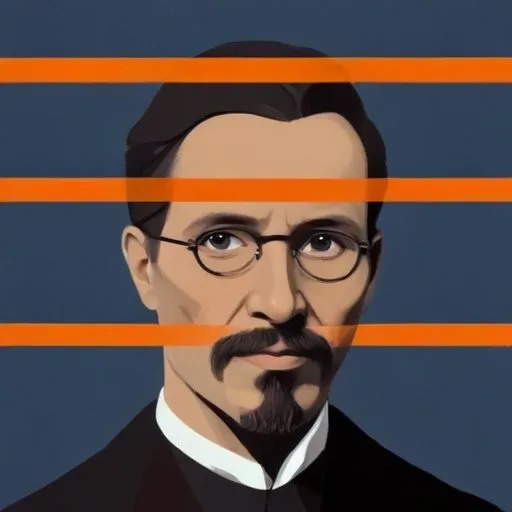
A Dutch mathematician and philosopher who founded intuitionism, a philosophy of mathematics that emphasizes the role of intuition in mathematical discovery, and made significant contributions to topology.
Luitzen Egbertus Jan Brouwer, affectionately known as L. E. J. Brouwer, was a Dutch mathematician and philosopher who left an indelible mark on the world of mathematics, particularly in the fields of topology, set theory, measure theory, and complex analysis. He is famously recognized as one of the founders of modern topology, and his groundbreaking fixed point theorem and topological invariance of dimension continue to shape the discipline.
Born on February 27, 1881, to Dutch Protestant parents, Brouwer's fascination with mathematics began at a tender age. His innate curiosity and talent earned him a spot at the University of Amsterdam, where he pursued his doctoral studies under the guidance of Dutch mathematician Diederik Korteweg.
Brouwer's contributions to mathematics are nothing short of phenomenal. He proved a plethora of theorems, including his iconic fixed point theorem, the topological invariance of degree, and the topological invariance of dimension. These breakthroughs not only underscored his genius but also redefined the landscape of topology.
Brouwer's philosophical pursuits led him to develop the concept of intuitionism, a constructivist school of mathematics that proposes that math is a cognitive construct rather than an objective truth. This perspective sparked a heated debate with formalist mathematician David Hilbert, known as the Brouwer-Hilbert controversy.
Brouwer's ideas and teachings had a profound impact on his students, including Arend Heyting, who went on to become a prominent intuitionist. His work also influenced notable mathematicians like Hermann Weyl. Today, Brouwer's legacy extends far beyond the realm of mathematics, with his philosophical and mathematical contributions shaping various fields, from philosophy to physics.
Brouwer's remarkable achievements earned him numerous accolades, including election as a member of the Royal Netherlands Academy of Arts and Sciences in 1912. He was also an invited speaker at the International Congress of Mathematicians in 1908 and 1912.
Brouwer's philosophical musings are documented in his 1905 tract, Life, Art, and Mysticism. This work showcases his unique perspective on the human experience, offering insights into the intricacies of life, art, and the mystical.
L. E. J. Brouwer's life's work serves as a testament to the power of human curiosity and innovation. His mathematical and philosophical contributions continue to inspire generations of scholars, cementing his place as one of the greatest mathematicians of the 20th century.
Born in 1853
Developed the theory of electromagnetism, predicting the existence of radio waves and paving the way for Einstein's theory of relativity. Contributed to the understanding of light, space, and time.
Born in 1862
A renowned mathematician and academic who developed infinite-dimensional vector spaces and laid the foundation for quantum mechanics and relativity. He's also famous for his 23 unsolved math problems that shaped 20th-century mathematics.
Born in 1882
A pioneering mathematician and physicist who revolutionized abstract algebra and made groundbreaking contributions to modern physics, particularly in the development of Einstein's theory of general relativity.
Born in 1885
A pioneer in combining mathematics and physics, known for his work on quantum mechanics, relativity, and the philosophy of science. He introduced the concept of gauge theory, which is crucial in modern particle physics.
Born in 1903
Pioneering mathematician and physicist who developed the concept of the modern computer architecture and made significant contributions to quantum mechanics and game theory. His work laid the foundation for modern computing and artificial intelligence.
Born in 1906
A groundbreaking logician and philosopher who shook the foundations of mathematics with his incompleteness theorems, proving that no formal system can be both complete and consistent.
